Eastern Wormsnake
Identification
Brown above, pink below, shiny enough to catch the light, and the most committed burrower on this list. Most people who find one assume they have turned up a large earthworm.
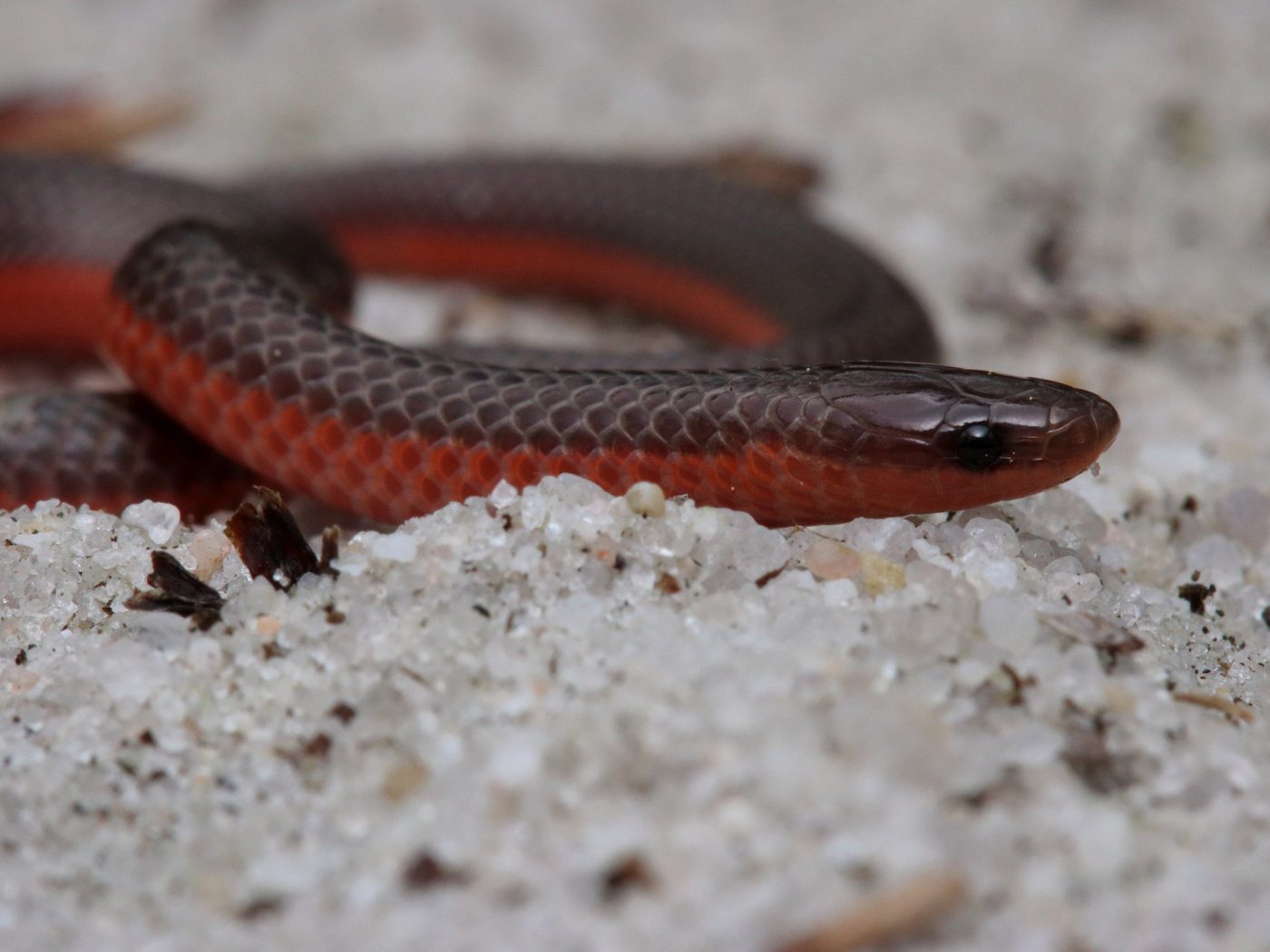
Held in a hand, a wormsnake presses the hard tip of its tail into your skin to lever itself forward, and people report being stung. It has no sting and no venom; it is trying to burrow through your palm.
Where to expect it.
Moist hardwood slopes, and all twelve county records fall between April and July.
Active Season
Charted from this species’ own research-grade records inside Williamson County.
What it gets mistaken for.
Two other small brown snakes share the same rock. The belly settles it every time.
A plain cream belly with no contrast. The wormsnake's pink belly stops in a hard line against the brown back.
Keeled scales and a dark streak on each side of the head. The wormsnake is smooth and blank-faced.
Scales, a visible eye and a tail that tapers to a point rather than a blunt end. Worms also do not move in an S.
When you meet one.
It tries to burrow. Into soil, into leaf litter, into the gap between your fingers.
Move it to shade.
Sun and dry air kill this animal fast. Set it under the nearest log or leaf pile rather than on open ground.
That is not a sting.
The tail tip is a digging brace. There is no stinger, no fang and no venom anywhere on this animal.
Net it out.
They fall in and cannot get out. A net and a damp shaded spot is the whole rescue.
Leave the tarp.
Sheet cover left flat on damp ground is prime wormsnake habitat and costs you nothing to keep.
Pack it. Print it. Pass it on.
Most snakes killed in Williamson County are killed by someone who could not name them. Send this to anyone who gardens, hikes, keeps a woodpile, walks a dog off the greenway, or has a teenager who reaches into things. That is most of the county.
Sources
Medical disclaimer. This field guide is general educational information, not medical advice, and is no substitute for professional diagnosis or treatment. Any bite from a copperhead or a timber rattlesnake is a medical emergency: go to an emergency department, and call the Tennessee Poison Center at 1-800-222-1222 on the way. In an emergency, call 911. Identification disclaimer. No photograph identifies a snake with certainty, and this guide will not make anyone a herpetologist. When the answer matters, keep your distance and send a photograph to someone who does this for a living.