DeKay's Brownsnake
Identification
The snake most likely to be living inside the city limits. It does well in gardens, rock piles, cemeteries, parks and empty lots, and it is the species people most often kill believing it is a newborn copperhead.
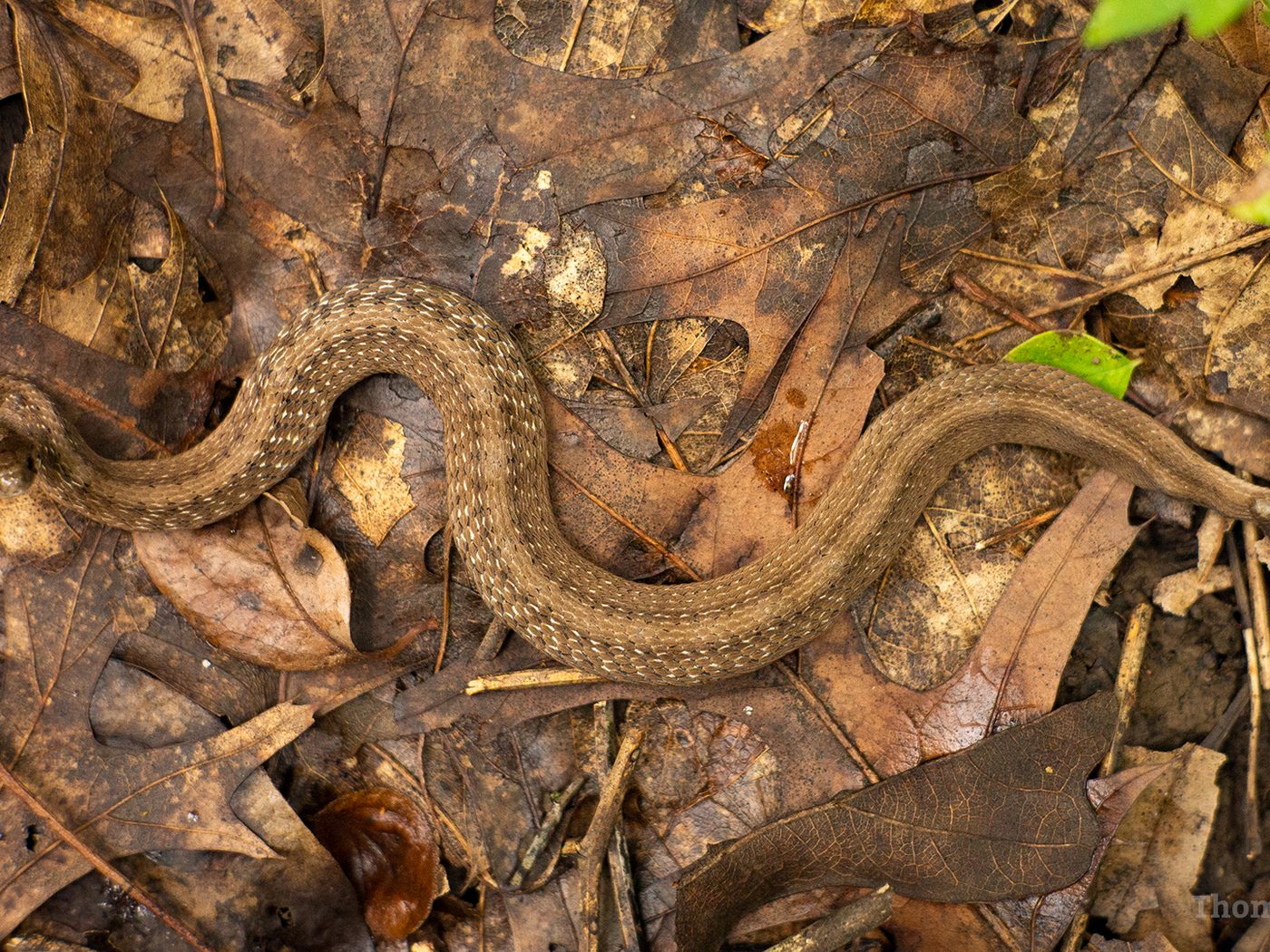
This is the snake the garden center pallet arrives with, the snake under the birdbath, and the snake in the window well. Of everything on this list it is the one most likely to be born, live and die inside a single Franklin subdivision.
Where to expect it.
Urban and suburban ground across the county, in places no other snake bothers with.
Active Season
Charted from this species’ own research-grade records inside Williamson County.
What it gets mistaken for.
It is not a baby copperhead. Nothing under a foot long and pencil-thin is a baby copperhead.
Newborn copperheads are eight to ten inches of thick-bodied snake with full hourglass crossbands and a bright yellow tail tip. A brownsnake is thin, spotted rather than banded, and has no yellow tail.
Turn it over. A red-bellied snake has a plain red belly; this one's is pale yellow to pink with small black dots.
Smooth scales and a bright yellow belly with a collar. The brownsnake is keeled.
When you meet one.
It flattens its body against the ground and stays still. It almost never bites, and it could not do much if it did.
Leave it.
A brownsnake is working through the slugs and snails in your beds, for free, at night.
Lift it out.
Window wells are traps. A trowel and a gentle lift into the nearest mulch bed is enough.
Sweep it to the door.
A soft broom and a low box, or a card slid underneath. It is too small to need anything more.
Photograph first.
One photograph on a phone settles it. Almost every "copperhead in the mulch" in this county is this snake or a juvenile ratsnake.
Pack it. Print it. Pass it on.
Most snakes killed in Williamson County are killed by someone who could not name them. Send this to anyone who gardens, hikes, keeps a woodpile, walks a dog off the greenway, or has a teenager who reaches into things. That is most of the county.
Sources
Medical disclaimer. This field guide is general educational information, not medical advice, and is no substitute for professional diagnosis or treatment. Any bite from a copperhead or a timber rattlesnake is a medical emergency: go to an emergency department, and call the Tennessee Poison Center at 1-800-222-1222 on the way. In an emergency, call 911. Identification disclaimer. No photograph identifies a snake with certainty, and this guide will not make anyone a herpetologist. When the answer matters, keep your distance and send a photograph to someone who does this for a living.