North American Racer
Identification
A long, slim, satin-black snake built entirely for speed across open ground. Despite the scientific name, it does not constrict: it pins prey under a body loop and swallows it alive.
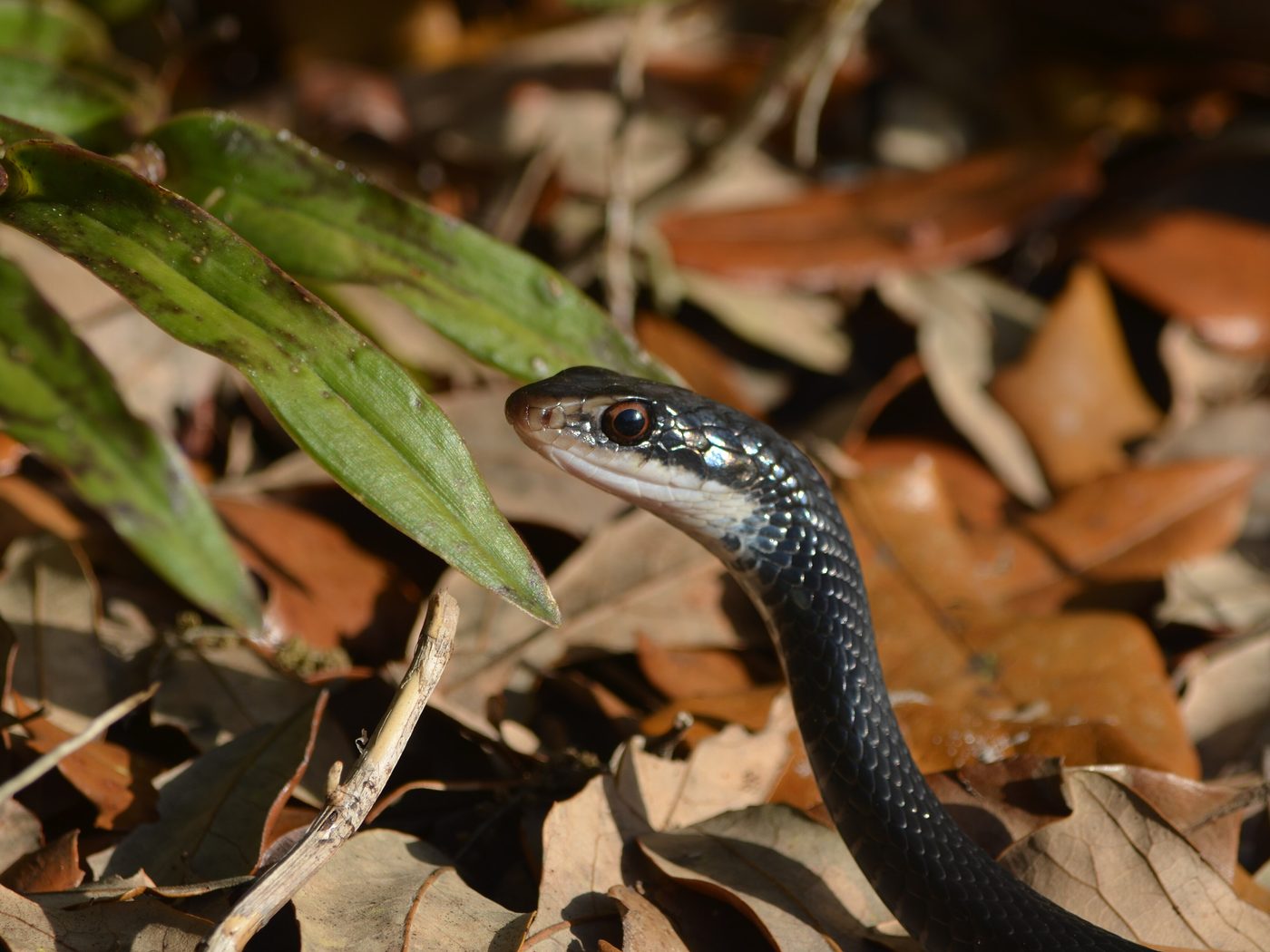
Racers hunt by sight, which is why one will periscope its head above the grass to look at you. That posture gets read as a threat and is nothing of the kind. It is checking whether you are worth running from, and the answer is always yes.
Where to expect it.
Open country: pasture, old field and the edges where field meets wood.
Active Season
Charted from this species’ own research-grade records inside Williamson County.
What it gets mistaken for.
The county has three large black snakes. Texture and cross-section separate them faster than color ever will.
The ratsnake is keeled, matte and loaf-shaped in section, and its juveniles have dark blotches on the tail. The racer is smooth, glossy and round, with a white chin.
A kingsnake carries white speckling on the back and a yellow checkered belly. A racer is plain.
Melanistic gartersnakes turn up and look black at a distance. They have keeled scales; a racer does not.
When you meet one.
It leaves at speed. Cornered, it vibrates its tail, strikes repeatedly and bites harder than anything else harmless on this list.
Stand still.
A racer will often stop a body length away and raise its head to look. Stay put and you get the best look at a snake this county offers.
It is not charging.
Racers flee along a chosen line and sometimes that line runs past your boots. Step aside rather than back.
Open both doors.
This species panics in an enclosure. Give it two exits and stop blocking the room.
Wash it well.
No venom, but racers chew and the wound is untidy. Soap, water, and a tetanus check if yours is out of date.
Pack it. Print it. Pass it on.
Most snakes killed in Williamson County are killed by someone who could not name them. Send this to anyone who gardens, hikes, keeps a woodpile, walks a dog off the greenway, or has a teenager who reaches into things. That is most of the county.
Sources
Medical disclaimer. This field guide is general educational information, not medical advice, and is no substitute for professional diagnosis or treatment. Any bite from a copperhead or a timber rattlesnake is a medical emergency: go to an emergency department, and call the Tennessee Poison Center at 1-800-222-1222 on the way. In an emergency, call 911. Identification disclaimer. No photograph identifies a snake with certainty, and this guide will not make anyone a herpetologist. When the answer matters, keep your distance and send a photograph to someone who does this for a living.