Rough Greensnake
Identification
The only snake in Williamson County that cannot be confused with anything else. TWRA's similar-species line for this animal reads, in full: none.
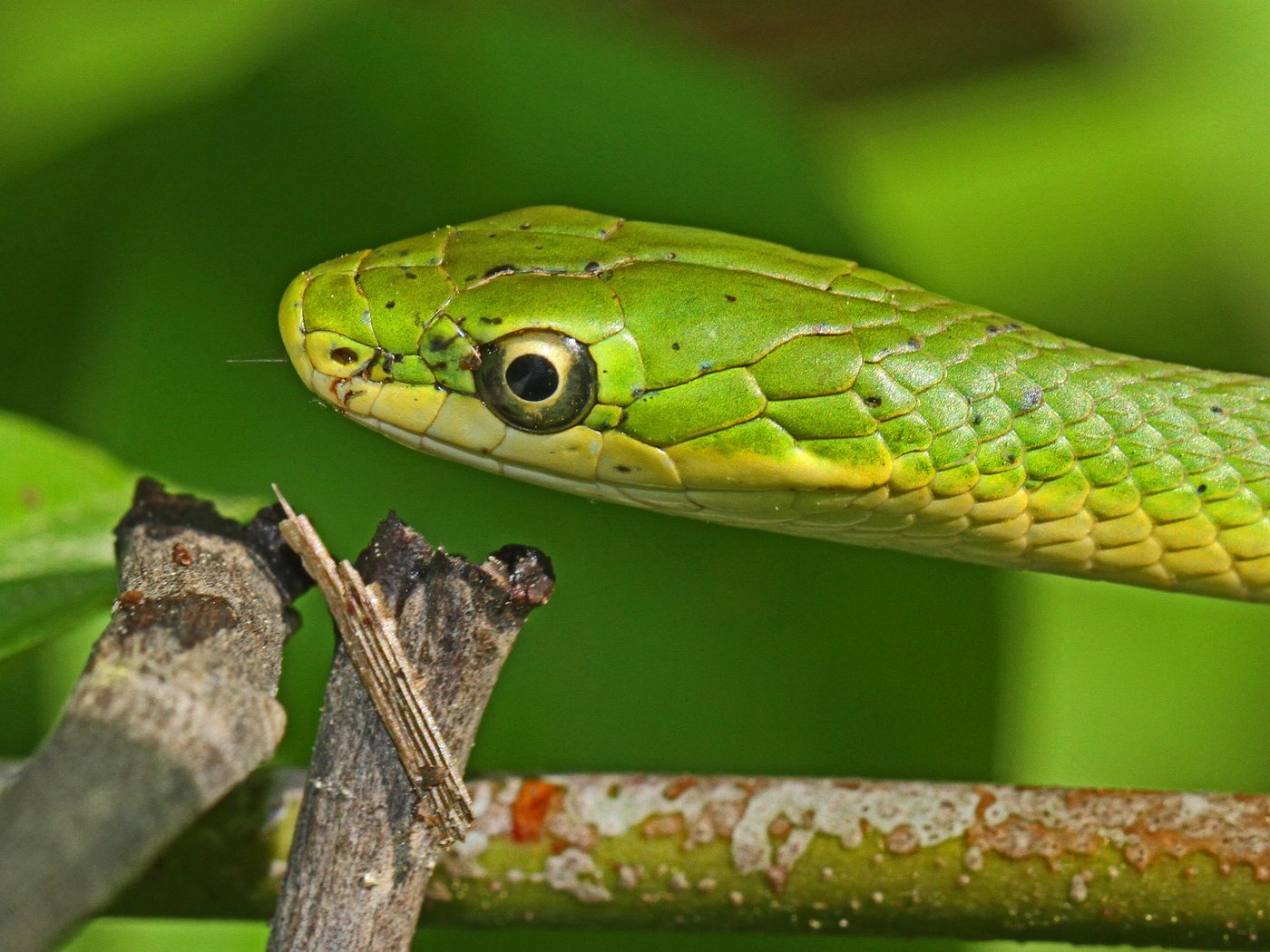
A preserved greensnake turns blue. The green is a yellow layer over a blue one, and when the yellow degrades the blue is all that is left, which is why museum drawers are full of blue snakes that were green when they were collected.
Where to expect it.
Along the wooded creek edges, and in September more than any other month.
Active Season
Charted from this species’ own research-grade records inside Williamson County.
What it gets mistaken for.
Nothing else here is green. The only question a greensnake raises is whether you saw a snake at all.
A northern species with smooth scales. It does not occur in the state, so a green snake in this county is this one.
This is the usual outcome. The snake holds still across a gap in the foliage, the eye reads stem, and it is gone before the brain catches up. Look for the horizontal line that does not attach at either end.
When you meet one.
It does not bite. In a county of snakes that at least bluff, this one simply freezes and hopes.
Leave it and look closer.
It is eating the caterpillars off your garden. It is the only snake on this list that is also a pest control service for plants.
Lift it out wet.
They fall in from overhanging limbs and cannot climb the smooth wall. A pool net gets it out unharmed.
Take it to a vet.
Cat saliva is fatal to small reptiles even when the wound looks trivial. A wildlife rehabilitator is the right call.
Put it on a branch.
Set it on a limb rather than the ground. This is an arboreal animal and the ground is where things eat it.
Pack it. Print it. Pass it on.
Most snakes killed in Williamson County are killed by someone who could not name them. Send this to anyone who gardens, hikes, keeps a woodpile, walks a dog off the greenway, or has a teenager who reaches into things. That is most of the county.
Sources
Medical disclaimer. This field guide is general educational information, not medical advice, and is no substitute for professional diagnosis or treatment. Any bite from a copperhead or a timber rattlesnake is a medical emergency: go to an emergency department, and call the Tennessee Poison Center at 1-800-222-1222 on the way. In an emergency, call 911. Identification disclaimer. No photograph identifies a snake with certainty, and this guide will not make anyone a herpetologist. When the answer matters, keep your distance and send a photograph to someone who does this for a living.