9
Seats: a mayor and eight aldermen
How Franklin works · City government
Franklin is run by a board of nine: a mayor and four aldermen elected by the whole city, and four more elected ward by ward. The mayor votes only to break a tie. Which of them answers to your address, how an ordinance becomes law in two or three readings, and how the board actually voted in 2026.
The City of Franklin is governed by its Board of Mayor and Aldermen, known around City Hall as BOMA. It has nine members. Four aldermen are elected by the whole city, in the same years as the mayor. The other four are elected one per ward, and only the voters of that ward choose its alderman. Every term is four years, and the two halves of the board are elected two years apart, on the fourth Tuesday in October of odd-numbered years.
The mayor runs the meetings but votes only to break a tie or to fill an empty alderman's seat. In 2026 there were no ties, so the eight aldermen cast every vote. The board confirms the city administrator, who runs the departments day to day; it sets the budget, the property tax rate and the fees on the city utility bill; and it decides every rezoning and annexation.
Its laws are ordinances, and most need two votes on two different days. Spending, a tax levy, a rezoning or an annexation needs three, and on the last of them five of the nine, however many are in the room. In 2026 the board met 17 times through October 13 and took 288 votes; 244 were unanimous. The next election is Tuesday, October 26, 2027, for the mayor and the four at-large seats.
Every address inside the city limits is in one of four wards. The city's address map, My Government Services, gives an address's ward, and the city's "Who's my alderman?" link sends residents there. The lookup below asks the same map. Type a street address; it goes from your browser to the City of Franklin's map service, not to us.
The example is the Franklin Theatre's address. The ward comes from the city's Government Services map; the names come from the board table in section 03, which we keep current. The ward map had not added Harlin, annexed in April, when we checked: its address, 1247 Hillview Lane, comes back inside the city but in no ward. Its annexation resolution put it in Ward 4. If the ward looks wrong, call City Hall at (615) 791-3217.
A mailing address that says Franklin is no guarantee: thousands of homes with a Franklin address sit outside the city limits, and they vote for the Williamson County Commission but not for this board. Inside the limits, the wards divide the city roughly by compass.
| Ward | Where, with some of the neighborhoods in it | People, 2020 |
|---|---|---|
| Ward 1 | The east and southeast: Cool Springs East, McKay's Mill, Avalon, Franklin Park, Cheswicke Farm, Liberty Hills, Royal Oaks, the Village of Clovercroft | 21,427 |
| Ward 2 | The north and northeast: Fieldstone Farms, Aspen Grove, the Landings, Gateway Village, Morningside, Cadet Homes, Monticello, Harlinsdale Farm and the Factory | 20,345 |
| Ward 3 | The south: Ladd Park, Berry Farms, Forrest Crossing, Stream Valley, Sullivan Farms, Lockwood Glen, Falcon Creek, Polk Place | 20,898 |
| Ward 4 | Downtown and the west: the historic district and Hincheyville, Westhaven, Hardison Hills, Franklin Green, Spencer Hall, Willowsprings, Boyd Mill Estates, and Harlin, annexed in April | 20,784 |
The neighborhoods are our count of the city's address points against its ward map, listing the subdivisions with the most addresses in each ward; a few large ones, like the CoolSprings Galleria's lots, straddle a line. The populations are the 2020 census counts for the wards the board adopted in 2022, from the city's redistricting charts.
The board redrew the wards after the 2020 census, which counted 83,454 people in Franklin, a third more than in 2010. Under the old lines Ward 3 had 24,223 people and Ward 2 had 18,087. Staff drew four options; the board chose the third at a May 2022 work session and adopted it as Ordinance 2022-16 on July 12, 2022, 8 to 0. Land the city annexes since then joins a ward named in its annexation resolution: the 311 acres of Harlin went into Ward 4.
The four at-large seats are Positions A to D, and a candidate files for one of them. The at-large aldermen and the mayor are elected citywide; a ward alderman must have lived in the ward for 60 days before the election and must keep living there. Nobody on the board faces a term limit, and Clyde Barnhill was first elected in 1988.
| Seat | Who holds it | On the board since | Next on the ballot |
|---|---|---|---|
| Mayor | Ken MooreMayor since 2011; an alderman at large before that | 2007 | Oct. 2027 |
| At large, Position A | Clyde Barnhill | 1988 | Oct. 2027 |
| At large, Position B | Brandy Blanton | 2011 | Oct. 2027 |
| At large, Position C | Greg Caesar | 2023 | Oct. 2027 |
| At large, Position D | Ann Petersen | 2007 | Oct. 2027 |
| Ward 1 | Beverly Burger | 2005 | Oct. 2029 |
| Ward 2 | Matt Brown | 2021 | Oct. 2029 |
| Ward 3 | Jason Potts | 2021 | Oct. 2029 |
| Ward 4 | Patrick BaggettVice mayor since November 2025 | 2021 | Oct. 2029 |
From the board's October 13, 2026 roll call, the city's member pages, and the Williamson County Election Commission's certified results. A new term starts on the second Tuesday in November after the election. Each member's city email is on the city's board page; email to them can be a public record. Each name links to the member's page here, with their 2026 votes.
Each November the aldermen elect one of themselves vice mayor for a year: Matt Brown in 2023, Jason Potts in 2024, Patrick Baggett in 2025, each 8 to 0. The vice mayor presides when the mayor is away and, since a 2023 change to the charter, votes on everything while presiding. If the mayor's office falls empty, the vice mayor serves until the next city election. An empty alderman's seat is filled by the board, by majority vote or a special election; when At-Large Alderman Pearl Bransford died in 2020, the board appointed John Schroer and put the rest of the term on the 2021 ballot.
The job pays $24,000 a year for the mayor and $12,000 for an alderman, unchanged since 2013. In October 2024 Alderman Burger proposed raising them to $48,000 and $27,000, then offered a smaller raise; it failed on first reading, 2 to 5. Under the charter a raise could not take effect until after the next city election anyway. The mayor also names the aldermen to the board's two standing committees, Budget and Finance (Barnhill, Petersen, Caesar and Brown since November 2025) and Capital Investment (Blanton, Burger, Potts and Baggett). The board itself selects the alderman who sits on the Planning Commission; Ann Petersen holds that seat through the term that ends in November 2027.
Franklin's charter makes the mayor the city's chief executive and the board its legislature, but the daily work belongs to the city administrator, a full-time manager the mayor nominates and the board confirms. Eric Stuckey has held the job since January 1, 2009. He prepares the budget, hires and fires the department heads, and signs contracts up to $75,000; the board raised that limit from $50,000 in April. Contracts above it, and the ones staff signed below it, appear on the board's agenda, the second kind as reports it does not vote on.
What comes to the board for a vote:
| The board decides | For example |
|---|---|
| The budget and the city's property tax rate | $0.296 per $100 of assessed value for the year that began July 1, the rate the board set in 2025 and held. See the property tax explainer. |
| Fees and utility rates | Water, sewer, stormwater and trash, set years ahead by ordinance. See the water bill and trash pickup explainers. |
| Rezonings, annexations and development plans | Harlin's 311 acres, after the Planning Commission's recommendation |
| Contracts above $75,000 | On October 13, a $17.6 million engineering contract and a health-benefits contract, both on the consent agenda |
| The city's laws | Speed limits, parking rules, the e-bike ordinance that passed its first reading on October 13 |
| Appointments | The city administrator; members of the Planning Commission and the other boards, on the mayor's nomination |
A good share of what residents bring to the board belongs to someone else. The Williamson County Commission sets the county's property tax, the larger part of a Franklin bill. Schools answer to the county school board or the Franklin Special School District's own board (see the school zoning explainer). State highways, Mack Hatcher Parkway among them, are the Tennessee Department of Transportation's. Elections are run by the county's election commission. Inside the city, the Planning Commission makes the final call on amendments to Envision Franklin, the land use plan, and the Board of Zoning Appeals hears variances.
The board meets at 7 p.m. on the second and fourth Tuesdays, once a month in July and December. A work session comes first, the same afternoon, usually at 5 p.m. Work sessions are for discussion: none of 2026's took a vote. Since February 2025, with City Hall being rebuilt (see the new City Hall walkthrough), both have been held in the Williamson County Auditorium, 1320 West Main Street.
Two committees of aldermen and a joint session with the Planning Commission meet on Thursdays. Budget and Finance usually meets on the second Thursday at 3 p.m.; Capital Investment on the fourth Thursday at 3:30. The joint conceptual workshop, the same afternoon, is where a big development gets its first public look, and what the aldermen say there binds no one.
The agenda goes up on the city's meeting portal, franklintn.portal.civicclerk.com, four to six days ahead, nearly always the Thursday before. The packet beside it holds the staff reports, maps and the full text of each ordinance. Every item carries a history line, for instance "FMPC 8/27/26, 6-0-1 (recusal) / WS 9/8/26 / BOMA 9/8/26, 6-2 to defer," which is the quickest way to see where something stands. Meetings stream live on each meeting's portal page and stay there; Franklin TV carries them on Comcast, AT&T U-verse and Roku, and the archive is on the city's YouTube channel.
| Board meeting | What is set so far |
|---|---|
| Tuesday, Oct. 27 | A public hearing on an amendment to this year's budget |
| Tuesday, Nov. 10 | Public hearings on two rezonings, Harpeth Village and Branch Creek Crossing. The charter has the board choose a vice mayor at its November meeting |
| Tuesday, Nov. 24 | Nothing posted yet |
| Tuesday, Dec. 8 | The year's last regular meeting |
From the city's meeting calendar on October 17, 2026. A special work session is also set for Monday, Nov. 2, at 3 p.m. at 900 Columbia Avenue, its subject not yet posted. The 2027 calendar is already up: Jan. 12 and 26, Feb. 9 and 23, March 9 and 23, April 13 and 27, May 11 and 25, June 8 and 22, July 13, Aug. 10 and 24, Sept. 14 and 28, Oct. 12, Nov. 9 and 23, Dec. 14.
The board acts in two forms. An ordinance is a law: the charter requires one to set a fee or a utility rate, levy a tax, adopt the budget, borrow money, set a fine, use the city's police power or change an existing ordinance. A resolution decides most other things in a single vote: contracts, development plans, plans of services for annexed land, appointments and policies. Annexation is the exception, done by resolution but on three readings. How many votes an item needs depends on what it is.
| What | Readings | To pass the last one | Public hearing |
|---|---|---|---|
| Most ordinancesA speed limit, a parking rule, a change to the code | 2, on separate days | A majority of the members present | Not required |
| Spending, a tax levy or a zoning changeThe budget, the tax rate, a rezoning | 3, on different days | 5 of the 9, however many attend | At the second reading; for the budget, ten days' published notice |
| AnnexationTaking land into the city, by resolution | 3, on different days, with a plan of services in one | 5 of the 9 | At the second reading |
| ResolutionsContracts, development plans, appointments | 1 | A majority of the members present | For development plans and plans of services |
Franklin's charter, Article V, sections 3 to 5, as amended in 2017 and 2023, and the zoning ordinance's Chapter 20. The fee ordinances, like the trash and water rates, also get three readings and a hearing in practice, though the charter lists only spending, taxes and zoning.
A quorum is five, and the mayor counts as a member. Every vote except a procedural one is a roll call, recorded in the minutes. Most items pass with a majority of the members present, so a first reading can pass 4 to 3 if only seven attend. The last reading of a budget, tax rate, rezoning or annexation cannot: it needs a majority of the entire board, five votes, and with the mayor voting only on a tie, that means five aldermen, or four and the mayor.
The minutes give the reason: a property tax levy needs a majority of the board, and four of nine is not one. Two more rounds followed, with $0.296, $0.300 and the proposed $0.32 each falling short 3 to 4. On the third try Patrick Baggett moved $0.296, Clyde Barnhill voted with him, and the rate passed 5 to 2. It is the rate Franklin still levies.
A rezoning, the most common contested item, runs the longest path, and the rezoning explainer walks it step by step. The applicant mails notice to owners within 500 feet, and for a planned development holds a neighborhood meeting; the Planning Commission hears it and recommends; then the board takes three readings, with the public hearing at the second, advertised in a newspaper at least 21 days before. Here is one from this year, from the minutes, with every roll call.
Big projects take many votes. Harlin needed four separate measures, a plan of services, the annexation, the zoning ordinance and a development plan, and its first readings in May 2025 were followed by five deferrals over eleven months. On April 28, 2026 the final votes split differently: the plan of services passed 6 to 2 and the zoning 6 to 2, with Ann Petersen and Greg Caesar voting no; the annexation passed 5 to 3, Clyde Barnhill joining them; and the development plan 5 to 3, Brandy Blanton joining them instead.
Most items never get that far. Staff recommends which items go on the consent agenda, which the board passes in one motion without discussion; any member can pull an item off it for a separate vote. In 2026 the 17 consent votes carried 145 items, including the third readings of this year's budget, the tax levy and the trash fee increase on June 23, each after hearings at earlier readings.
The mayor's vote is rare, and 2026 needed none. Ken Moore broke ties on the new City Hall's schematic design in May 2023, 5 to 4, and on the trash fee increase in June 2024, at its second and third readings. A motion to reconsider can be made only at the same meeting as the vote.
We read the minutes of all 17 regular meetings from January 13 to October 13 and recorded every vote: 288, counting each consent agenda as one. Fifty-six were procedural, setting the agenda, approving minutes, adjourning. 244 were unanimous. Forty-four drew at least one no, six motions failed, nobody recused, and one alderman abstained once. None tied, so the mayor never voted.
The board adopted 27 ordinances on final reading and 78 resolutions. The arguments cluster in one place: 33 of the 44 split votes were on annexing land, zoning it or approving what would be built on it. Harlin, the 79.89 acres beside it on Hillview Lane, Poplars Reserve and the Clovercroft Road annexation in August, and the hillside line in section 06 account for most of them. The narrowest votes to pass were 5 to 3, three times: Harlin's annexation and development plan, and a redesign of the Liberty Pike and Mallory Lane intersection in March.
| Alderman | Votes cast | Voted no | Not voting |
|---|---|---|---|
| Ann PetersenAt large | 288 | 12 | 0 |
| Greg CaesarAt large | 279 | 24 | 9Absent March 10 |
| Brandy BlantonAt large | 217 | 5 | 71Absent five meetings; left June 9 early |
| Clyde BarnhillAt large | 288 | 8 | 0 |
| Beverly BurgerWard 1 | 281 | 6 | 7Absent April 14; one abstention |
| Matt BrownWard 2 | 276 | 7 | 12Absent May 12 |
| Jason PottsWard 3 | 279 | 11 | 9Absent March 10 |
| Patrick BaggettWard 4 | 269 | 16 | 19Absent Sept. 22 and Oct. 13 |
Every motion counts, amendments, deferrals and procedure included, and an item voted at three readings counts three times. The minutes of August 11 and 25 and September 8 print 13 split votes as tallies without names; those names come from the city's own roll-call record on its meeting portal, which agrees with the minutes on every split vote where both name names. On June 23 the minutes record the Armistead infrastructure district as 7 to 0 and the portal records Petersen voting no; we used the minutes. The October 13 minutes are a draft until the board approves them.
Caesar, first elected in 2023, cast the most no votes, 22 of his 24 on annexations, zoning and development plans, Harlin's final four among them. Eleven of Baggett's 16 came at the two August meetings, on Poplars Reserve, the Clovercroft Road annexation and the Bassett development plan; the minutes give those as tallies, and his name comes from the portal's roll call. Potts's 11 include the hillside line at all three readings. A no is a vote against the motion on the floor, which is not always the project: on June 9 six aldermen voted no on deferring a requested annexation study on Arno Road, then all eight voted to deny the study. Any of these votes can be checked on the meeting's portal page, where the video sits beside the minutes, and each member's page lists every split vote of the year with how they voted.
Anyone can speak at a board meeting on any subject. Fill out a speaker card before the meeting starts; citizen comments come early, right after recognitions, and the standard is two minutes each when time allows. The mayor can shorten the period or the number of speakers. The board takes no action that night on something that is not on the agenda; at most it refers the matter to the city administrator or schedules it. Comments on an agenda item can also be emailed to recorder@franklintn.gov before noon on the day of the meeting, and they go into the record. Work sessions take comments on their agenda items only.
A public hearing is different: it belongs to one item, and people speak when that item comes up. Thirteen residents spoke against Harlin's plan of services on April 28. For a rezoning, an annexation or the budget, the hearing is at the second reading, so the first reading is the signal to start paying attention.
It helps to start earlier. By the time a rezoning reaches the board, the Planning Commission has already made its recommendation, and for a large project the conceptual workshop and the applicant's neighborhood meeting came before that. Owners within 500 feet get the applicant's letter; everyone else has to watch the agendas. Tennessee law has required a period for public comment on agenda items since July 2023, and since March 2026 on any matter within the board's reach, which Franklin's agenda already allowed.
Each alderman's email is on the city's board page, and the recorder's office at recorder@franklintn.gov answers questions about the board. Residents can also apply for one of the city's boards and commissions through its online portal; the mayor nominates, and the board votes on each appointment.
On Tuesday, October 26, 2027, every Franklin voter, in every ward, can vote for the mayor and the four at-large seats, the seats now held by Moore, Barnhill, Blanton, Caesar and Petersen. The four ward seats come up two years later, on October 23, 2029, and each ward votes only for its own.
To vote, a person must be registered and have lived in the city for 90 days, or be a Tennessee voter who owns taxable real property inside the city without living there; no more than two people can register on one property that way. The Williamson County Election Commission runs the election, at vote centers any city voter can use, with polls open 7 a.m. to 7 p.m. and early voting from 20 to 5 days before. Photo ID is required. The races are nonpartisan, and the candidate with the most votes wins, with no runoff.
To run, a candidate files a petition signed by at least 25 registered city voters with the election commission at 405 Downs Boulevard. State law sets the deadline at noon on the third Thursday of the third month before the election, which for 2027 is July 15. A candidate must have lived in Tennessee for a year and in the city for six months; the mayor must be at least 25. When petitions become available is not yet posted; in 2025 it was about two months before the deadline. The commission's number is (615) 790-5711.
| October 24, 2023 | Winner | Votes | Runner-up |
|---|---|---|---|
| Mayor | Ken Moore | 12,822 | Gabrielle Hanson, 3,322 |
| At large, Position A | Clyde Barnhill | 11,837 | Unopposed |
| At large, Position B | Brandy Blanton | 10,946 | Gary Moore, 4,666 |
| At large, Position C | Greg Caesar | 10,336 | Patrick George, 4,249 |
| At large, Position D | Ann Petersen | 10,961 | Jeff Feldman, 4,243 |
The county election commission's certified results. A third candidate for Position C, BK Muvvala, received 825.
Few people vote. The 2023 mayor's race drew 16,144 votes, about a quarter of the roughly 61,000 registered voters reported before the election. The 2025 ward races drew about 4,400 ballots, 7.4 percent of 59,901 registered, by the unofficial count newspapers reported; the commission certified the results on November 7, 2025 but has not posted the tally. All four ward aldermen were re-elected, and two ran unopposed. In 2021 Ward 3 was decided by 25 votes, Jason Potts 1,091 to Michelle Sutton's 1,066.
The rules could still change before 2027. A 2026 bill that began as a plan to make city elections partisan passed the state House 67 to 26 in April in a narrower form, moving them to August or November before 2030, and stalled in a Senate committee; it died when the session ended on April 23. The calendar, the seats and how the four at-large aldermen voted in 2026 are in our guide to the 2027 election.
The rules are from Franklin's charter, a private act of the General Assembly, read in the 2021 codification and in the acts that amended it since, and from the municipal and zoning codes; where the code we could read dates from 2021, the page relies on it only where the city's practice in 2026 matches. The members, committees and pay are from the board's minutes and the city's pages. The 2026 vote record is our own: every roll call in the 17 sets of minutes, most of them scanned images we read page by page, checked against the city's roll-call record on its meeting portal. The wards are from the city's ward map, which the lookup asks live, and the neighborhoods in the ward table are our count of the city's address points against it. Election results are the county's certified results, except for 2025, where only newspapers' unofficial counts are public. The stamp at the top says when we last checked.
Correction, October 21, 2026: this explainer first said the House passed a bill to make city elections partisan. The partisan provisions were struck on the House floor before the 67 to 26 vote; the version that passed only moved city elections to August or November.
Next
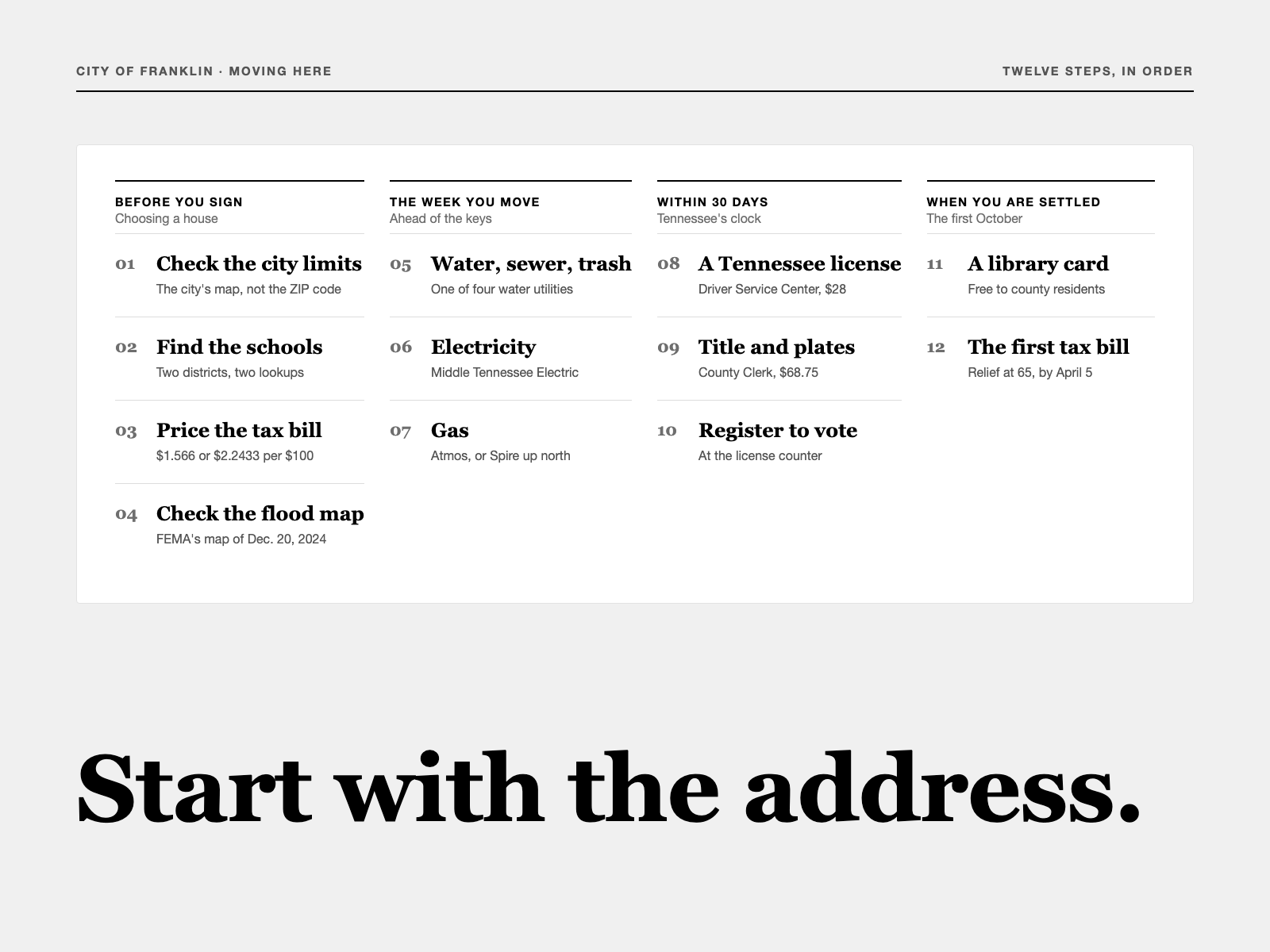
Twelve steps in the order they fall due: what to check before signing, what to start the week you move, and the 30-day clock on a license, plates and a voter registration.
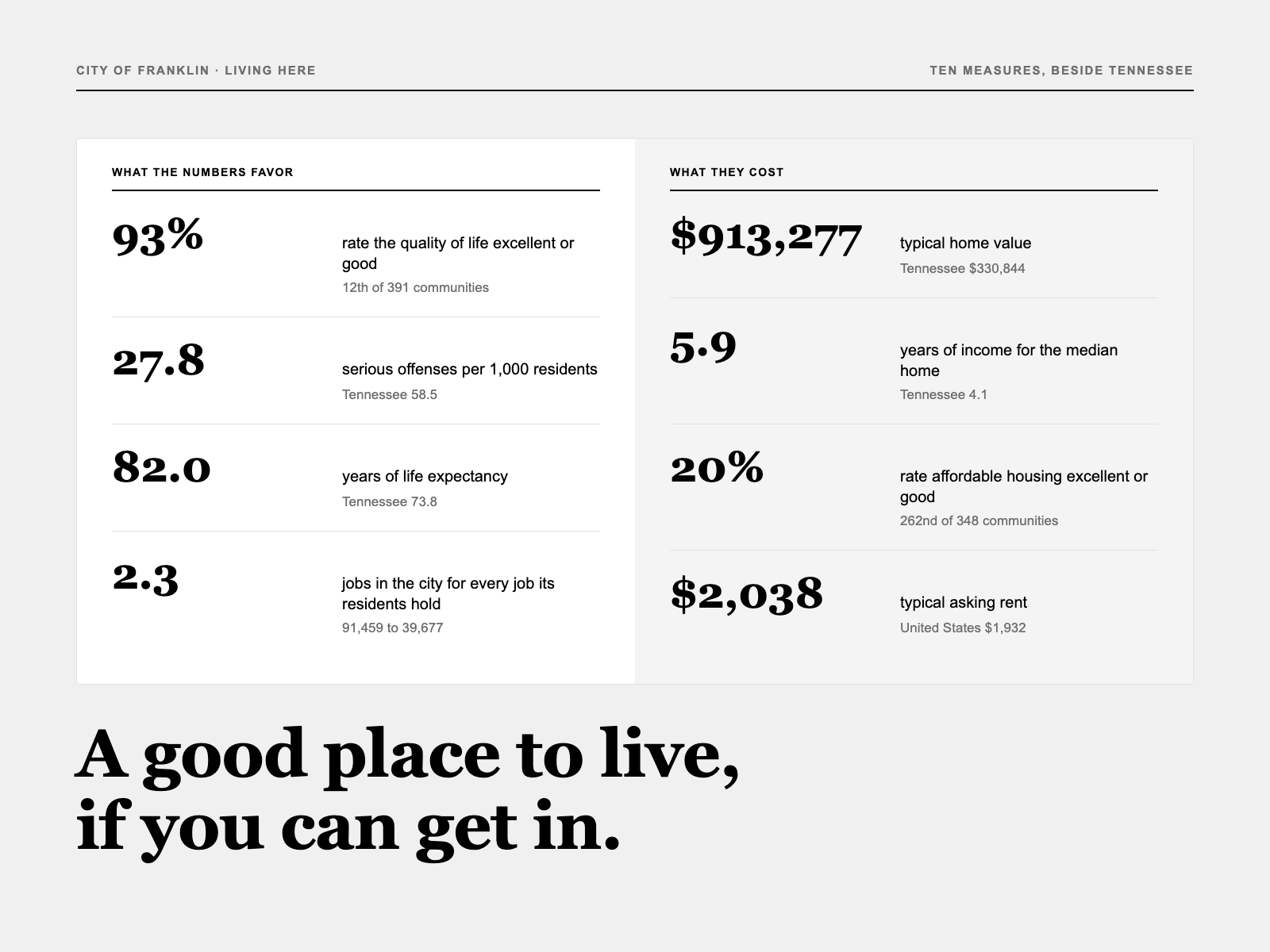
What residents say in the city's own survey, then the figures for cost, schools, crime, health, jobs, commuting, weather and the river, each beside the state's, and which households carry the costs.

The town the rest of the county is measured against. What a house costs by tier, the county-city-FSSD tax stack with a worked example, two school districts and four high schools, the honestly timed I-65 commute, the six character areas, the 2026 festival calendar, and the trade-offs nobody selling a house will mention.
Most of Franklin's 288 votes this year were unanimous, and the ones that were not are where the town's arguments are. We read every agenda and set of minutes and send the plain-English version, with who voted which way, before the next reading.