31,265
More people in Franklin's three ZIP codes than in the city, 2020
How Franklin works · Moving here
A Franklin mailing address does not put a house in Franklin, and the address decides the schools, the tax rate, the water bill and the ballot. The checklist for a household moving here, in the order the steps fall due: what to check before signing, what to start the week you move, and the 30-day clock on a Tennessee license and plates, each with the office, the cost and the explainer that goes further.
Before you sign
While choosing a house or an apartment
The week you move
A few business days ahead of the keys
Within 30 days
Tennessee's clock for a new resident
When you are settled
The first weeks, and the first October
Start with the address. A Franklin mailing address is the Postal Service's, and the city's limits are drawn somewhere else: the three ZIP codes on Franklin mail held 114,719 people in the 2020 census, 31,265 more than the city did. Inside the limits, the address decides which district teaches a child through eighth grade, the property tax rate, which of four utilities sells the water, which of two companies brings the gas, and the ward and county commission district a voter lives in. Each has its own map, and the first four answers change what a house costs, so check them before signing a lease or a contract.
Then the clock starts. Tennessee gives a new resident 30 days to trade an out-of-state driver's license for a Tennessee one, and the Department of Revenue says to register the car within 30 days of the move. Get the license first. It costs $28 at the state's Driver Service Center on Carothers Parkway, Tennessee's online voter registration asks for its number, and from January 1, 2027, when a car's first Tennessee registration starts to require proof of citizenship or lawful presence, it is the simplest proof to hand the county clerk. The clerk charges $68.75 to title and plate a new resident's car, the county's wheel tax included, and no sales tax is due on a car already titled in the owner's name.
The steps below are in the order they fall due, each with the office that handles it, what it costs and the explainer that covers it in depth. In the census survey for 2020 to 2024, 4.4 percent of Franklin's residents had moved in from another state within the year, about 3,800 people, and 6.2 percent from another Tennessee county. A household coming from elsewhere in Tennessee keeps its driver's licenses but not its voter registration, which does not follow a voter from one county to the next.
The Postal Service draws ZIP codes around mail routes and the city draws its limits one annexation at a time; the two do not match. ZIP code 37064 alone covers about 184 square miles, four times the city, and runs out to Leiper's Fork. By our count of the city's own address points, which stop well short of the county's rural edges, 5,961 of the 53,634 addresses with a Franklin ZIP code are outside the limits, about one in nine; in 37069, on the north side, it is more than a third. And the land beyond the line is lived on: in 2020 about 11,100 people lived inside Franklin's urban growth boundary, the land Tennessee's 1998 growth law reserves for the city to annex, but outside the city itself.
The answer changes the bills and the ballot. Inside the limits, the city picks up the trash, sends the sewer bill and adds $0.296 per $100 of assessed value to the county's property tax, and its residents elect a ward alderman and the mayor. Outside them, in unincorporated Williamson County, the city collects nothing at the curb, a household hires a hauler or drives to a county convenience center, there is no city tax line, and the county commission is the local government.
Two of our lookups ask the city's current limits map. The district lookup in our County Commission explainer answers "Inside the city" or not, with the county district, and the zoning lookup in our rezoning explainer says "Outside the city limits" when that is the case and names the zoning when it is not. The map lags the board's annexations: on October 19, 2026 it still left out Harlin, annexed in April. For land annexed this year, call City Hall.
The address decides the schools, and in central Franklin it decides the district too. Williamson County Schools teaches most of the city's children. The Franklin Special School District, a separate district with its own board and its own tax, teaches kindergarten through eighth grade inside the city limits as they stood in 1986, and its students go on to a county high school. A ZIP code takes in both, and the FSSD's own list marks eight neighborhoods divided between them.
So run the address, not the subdivision, through both lookups: the county district's, on its Bus Routes & School Zones page, which names the high school and, outside the FSSD, the elementary and middle schools; and the FSSD's District Map, for the two younger schools inside it. A listing's "zoned for" line is a guess. Our school zoning explainer walks through both lookups and what to do when a line is about to move.
To enroll, the county district asks for one proof of residency (a signed lease, a settlement statement, a warranty deed or a current mortgage statement), a utility bill from the month before, a parent's photo ID, the child's birth certificate, and immunization and physical records. A kindergartner has to turn five on or before August 15. A family whose house is not ready can enroll at the new zone's school early with a signed, non-contingent contract; one moving in from outside the county pays the semester's tuition up front, at this year's rate of $9,797 a year, and gets it back if it proves residency before the semester ends.
Inside the city, the rate depends on one more line, the FSSD's. A Franklin home outside the FSSD pays $1.566 per $100 of assessed value for 2026, and one inside it $2.2433, because the district levies its own $0.7673. A house is assessed at a quarter of its appraisal, so on one appraised at Redfin's median Franklin sale for July to September, $863,089, the year's bill comes to about $3,379 outside the FSSD and $4,840 inside it. The FSSD's map answers the school question and the tax question at once, and our property tax explainer works the bill for any value. Tennessee does not tax wages.
The bill comes once a year, in early October, and can be paid without interest through the end of February. It goes to whoever owned the house on January 1, so a house bought in the spring of 2026 gets its first bill in the buyer's name in October 2027; the 2026 bill goes out in the seller's.
The Harpeth River runs through the middle of the city, and FEMA counts 1,769 Franklin properties in its floodplain, by the city's account. The river's gauge at Franklin is in flood at 30 feet. It has reached that in 6 of the 51 years since 1975, most recently in March 2021, and the record is 35.32 feet, on May 2, 2010. At 30 feet, the Weather Service says, water reaches parts of Hillsboro Road between Highway 96 and Fieldstone Parkway, properties north of Bridge Street downtown, and homes on Rebel Circle, Crafton Avenue and Allen Avenue.
Look the address up on FEMA's flood map before signing. Most of the map is new: 13 of the 20 panels that cover Franklin were redrawn by FEMA's Harpeth River watershed study and took effect on December 20, 2024, and no newer map is pending. The city's floodplain administrator will say which zone a property is in, free, and keeps elevation certificates for many properties. Tennessee's seller disclosure form, as the legislature wrote it in 1998, asks about flooding and about any requirement to carry flood insurance.
A standard homeowner's policy does not cover flooding, the city's floodplain page warns, and more than a quarter of the federal flood program's claims, it adds, come from outside the 100-year floodplain. A federal flood policy bought after moving in waits 30 days to take effect; one bought while taking out or refinancing the mortgage starts at once. Franklin's floodplain work earns its residents a 10 percent discount on federal flood insurance, as a Class 8 community in FEMA's rating system.
Inside the limits the city sends the bill for sewer, stormwater and trash, and one of four utilities sells the water. About six in ten Franklin properties are on city water; the rest buy it from one of three utility districts, each with its own board and rates. A household on district water opens two accounts, one with the district and one with the city. The city's address map has the four territories, and near an edge the city's billing office is the one to ask.
| Water utility | Where in Franklin | Phone |
|---|---|---|
| City of Franklin | Downtown, Fieldstone Farms, Berry Farms, Founders Pointe, Spencer Hall, River Landing | (615) 794-4572 |
| Mallory Valley Utility District | Cool Springs, Ashton Park, the Galleria, part of McKay's Mill | (615) 628-0237 |
| Milcrofton Utility District | Most of McKay's Mill, Avalon, Ladd Park, Lockwood Glen, Amelia Park | (615) 794-5947 |
| HB&TS Utility District | Westhaven | (615) 794-7796 |
From our water bill explainer: the city's Water Districts layer, checked against the subdivisions in its parcel records. Sewer, stormwater and trash are the city's at every address inside the limits.
Opening a city account takes an application, a copy of a photo ID and a $50 fee, which can go on the first bill; there is no deposit. A renter adds a copy of the lease, signed by the landlord and listing every tenant. The billing office asks for 24 hours' notice by phone, and the city's policy and form say three business days, so allow three. The first bill comes 30 to 45 days after the connection. A 6,000-gallon month on city water came to $148.90 this year for water, sewer, stormwater and one trash cart, and will be $157.93 from January 1.
The 96-gallon trash cart stays with the house, and on a move the city makes one courtesy pickup of the extra trash, on a call to Sanitation at (615) 794-1516. Pickup is once a week, on one of four days, and the lookup in our trash explainer gives the day. Curbside recycling is extra and opt-in: a one-time $75 for the blue cart, then nothing more a month. The trash fee is $33 a month on the utility bill, and $34 from January 1.
Middle Tennessee Electric, a cooperative owned by its customers, is the city's electric utility, and the city's page for new residents names no other. Start service on its website or by phone; requests are worked on weekdays, and one needed within two business days has to go through the phone line. Every customer is a member and pays a one-time $5 fee, and connecting a home that has had MTE service costs $40, or $75 for new construction, both on the first bill. A soft credit check sets the deposit at nothing, $150 or $300, due before the power comes on; MTE's prepaid billing avoids it, and a deposit comes back after 24 on-time payments. At October's rate, $21.81 a month plus 10.244 cents a kilowatt-hour, 1,000 kilowatt-hours cost $124.25.
Gas depends on the street. Atmos Energy serves most of the city, about 23,000 customers inside the limits when the state's utility commission last counted, in 2018. Spire serves pockets along Moores Lane on the city's northern edge, on both sides of I-65, by our reading of the map of its pipe that Piedmont Natural Gas filed with the state in 2020. Piedmont's Tennessee business became Spire's on March 31, 2026, and Piedmont still answers Spire's phone and sends its bills until the handover is complete in 2027. Neither company has an address lookup, so ask the seller or the landlord which one serves the house, or call.
Atmos charges $40 to turn the gas on at a home that has had service, and can ask a customer without credit references for a deposit of up to two months' estimated bills, returned after two years of paying on time. Spire charges a new customer nothing to turn it on, but it books a technician's visit and needs the electricity and water on first, so call it early. If you smell gas, leave the house and, from a safe distance, call 911 and Atmos at 866-322-8667 or Spire at 800-752-7504.
A new resident with a license from another state has 30 days after moving in to get a Tennessee one, and has to do it at one of the state's full-service Driver Service Centers. Franklin has one, on Carothers Parkway. The county clerk does not handle licenses, and the state's kiosks only renew and replace them. The license costs $28 and is good for eight years. A REAL ID costs the same, and one from another state does not carry over, so a new resident brings the full set of documents again.
Bring originals; photocopies are refused. The list is one proof of U.S. citizenship or lawful presence, such as a U.S. passport or a birth certificate; proof of a Social Security number, which for a REAL ID has to be a document showing the whole number; two proofs of a Tennessee address, each dated within four months and not from the same source, such as a utility bill and a bank statement (a lease counts only with a signed letter from the landlord); and the out-of-state license, which the examiner keeps. Drivers coming from California, Connecticut, Illinois, Nevada or West Virginia also need their driving record from that state. Everyone takes a vision screening. The written and road tests are waived unless the old license expired more than six months ago.
The state's online e-Services will take the application and check the documents ahead of the visit; allow up to five business days for that. At the counter, ask to register to vote: the center sends the form on to the county. A driver moving here from another Tennessee county keeps the license but has to give the state the new address within 10 days, online, at a kiosk or by mail, at no charge. Updating a voter registration does not do it.
The law that changes car registration in January, Public Chapter 954, also rewrites the license rules from January 1, 2027, to call for documentation of U.S. citizenship. When we checked, the department's pages still listed the documents for permanent residents and others here lawfully, and had not said how the change will apply to them.
The Department of Revenue says a new resident should register a car within 30 days of the move, and in Williamson County that is done at the county clerk's office in the administrative complex on West Main Street. Whoever's name goes on the registration has to come in person. Bring proof of identity (a driver's license or a passport does it), two proofs of a local address, the car's most recent out-of-state registration and its out-of-state title. If the car has a loan, the lender holds the title, so bring the lender's name and mailing address instead.
The clerk's fee for a new resident's car is $68.75, which covers the plate, the Tennessee title and the county's $25.75 wheel tax, plus $11 to record a loan. With no loan, the plate goes home the same day. No sales tax is due on a car already titled or registered in the owner's name before the move; one titled to someone else pays the difference between the tax paid elsewhere and Tennessee's. And there is no emissions test: Williamson County stopped requiring one on January 14, 2022. A renewal costs $54.75, wheel tax included, by mail, online or at one of the county's kiosks. An electric car adds $200 at renewal, $274 from January 1, 2027, and a hybrid $100.
Two changes are coming. From January 1, 2027, under Public Chapter 954, the clerk cannot process a car's first Tennessee registration until the owner shows proof of U.S. citizenship, permanent residence or a lawful temporary stay; renewals are exempt. A REAL ID from any state, or any Tennessee license or ID, counts as that proof, which is one more reason to get the license first. From July 1, 2027, under Public Chapter 1077, a first registration also needs proof of insurance, on a policy good for at least 30 days.
The deadline is 30 days before an election. Online, on the state's GoVoteTN site, the form asks for a Tennessee driver's license or ID, because it takes the voter's signature from the Department of Safety's records. So a new arrival registers at the license counter, on a paper form mailed or carried to the election commission, or online once the license is in hand. A registration does not carry over from another Tennessee county; a voter moving in from one registers again. The card can take three weeks to arrive.
The deadline for the November 3 state and federal election passed on October 5. The next election on a Franklin ballot is the city's, on Tuesday, October 26, 2027, for mayor and the four at-large aldermen. Voting in it takes 90 days' residence in the city as well as registration 30 days ahead, a deadline that falls on a Sunday. In 2025 the commission moved the same Sunday deadline to the Monday, September 29, and it posted that notice in June.
At the polls Tennessee asks for a photo ID issued by the state or the federal government. An out-of-state driver's license does not count; a U.S. passport does. A voter who registered online or by mail votes in person the first time, and the county asks first-time voters to show proof of address, so bring a current utility bill or bank statement. To see whose names will be on the ballot, the ward lookup in our Board of Mayor and Aldermen explainer names the ward alderman, and the district lookup in our County Commission explainer names the two county commissioners.
A library card is free to Williamson County residents at the county's public library: the main library on Columbia Avenue, a mile south of downtown, and five branches, in Bethesda, College Grove, Fairview, Leiper's Fork and Nolensville. Start the application online or at the desk, then pick the card up at a branch with a photo ID and proof of address; a driver's license showing the current address does both. A child can have a card from age 4, with a parent or guardian there to sign. A card borrows up to 40 items, takes e-books and audiobooks through the Libby app, and at the main library checks out passes to Carnton, the Carter House, the McLemore House and the Frist Art Museum.
The first tax bill is the last step, in October. Owners 65 and older can apply, after paying it, for the county's tax freeze, which holds the county tax at its level in the year the owner qualifies, for a 2025 income of $69,150 or less, or for the state's tax relief, which pays part of the bill back, for one of $38,470 or less. The deadline for the 2026 bill is April 5, 2027. Franklin has not adopted the freeze for its city tax, and it waives its monthly trash fee for households in the state's relief program.
Every step is from the office that handles it, read from its own pages, rate schedules and tariffs, and the figures are typed into figures.json beside this page's record with their sources; the census figures are the population explainer's file, the tax rates the property tax explainer's, and the water, school and tax relief details are held to the explainers that cover them. A test rebuilds the checklist and the figures in the prose from those files. Where a figure or a date is ours (the addresses outside the limits, the 2027 registration deadline, the Spire streets read from a 2020 map), the sentence says so. The stamp at the top says when we last checked.
Next
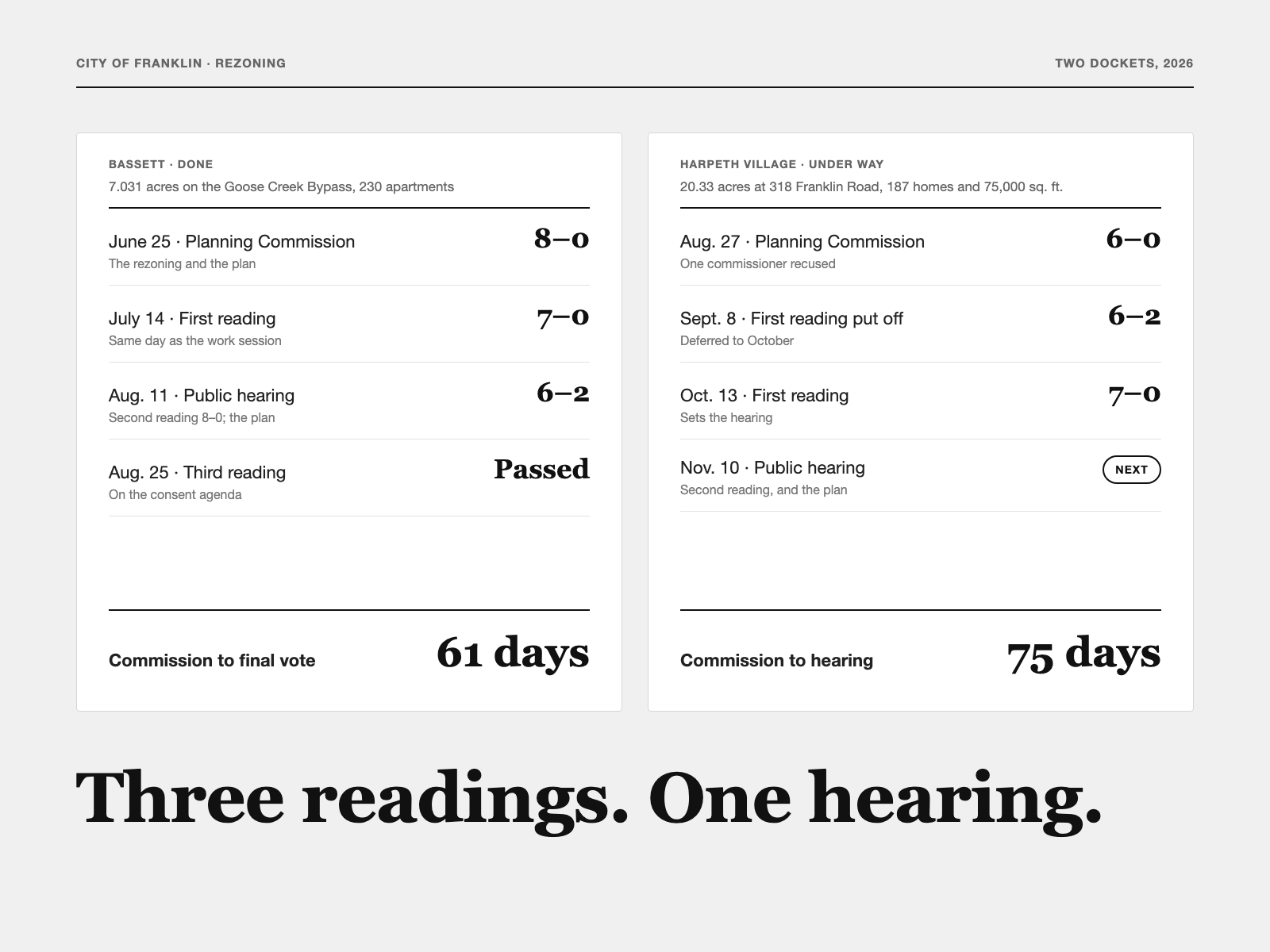
Who files, what the Planning Commission decides, the board's three readings and the one public hearing, the two rezonings with hearings on November 10, and what the state's review deadlines change from January 1.
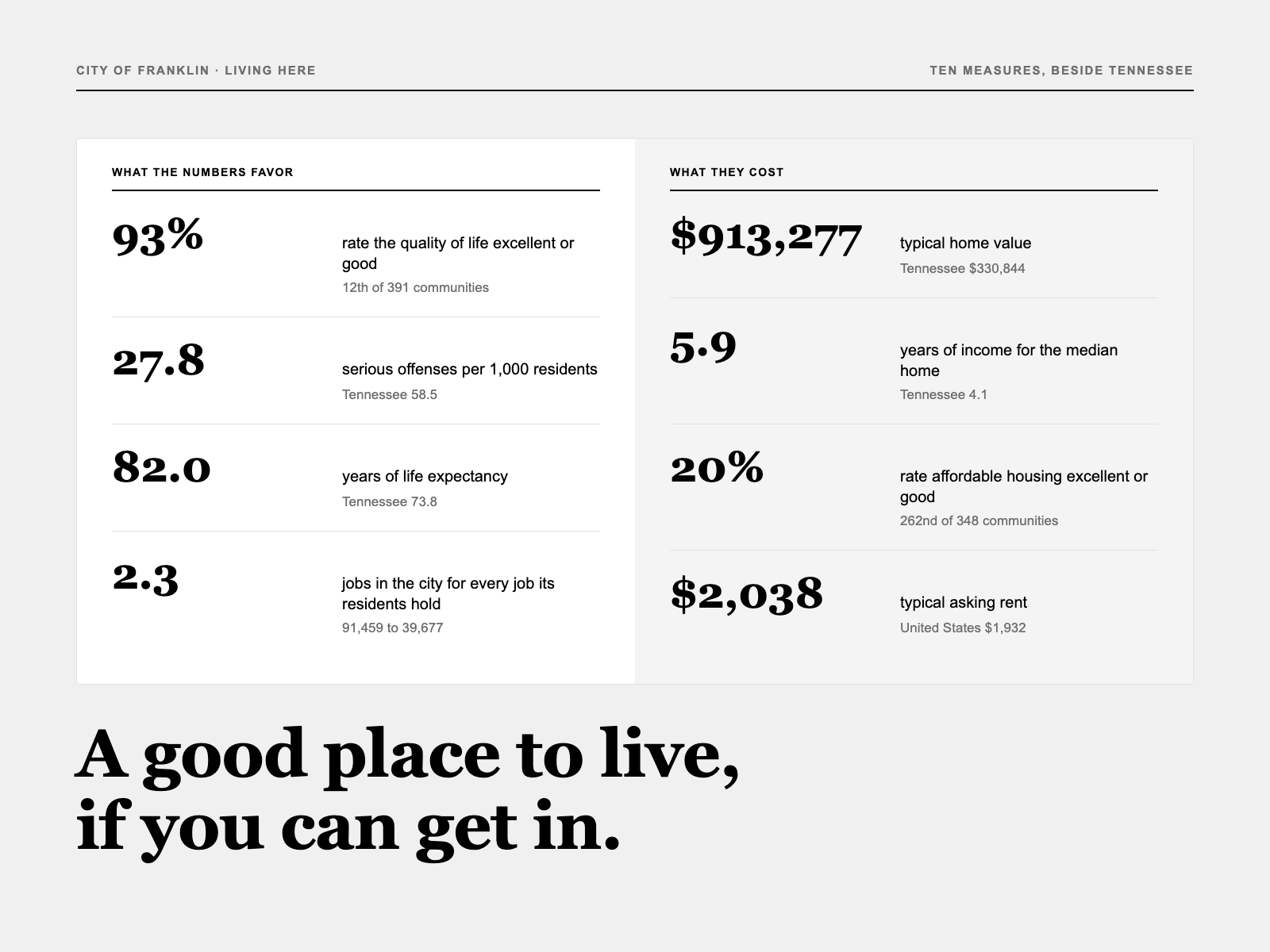
What residents say in the city's own survey, then the figures for cost, schools, crime, health, jobs, commuting, weather and the river, each beside the state's, and which households carry the costs.
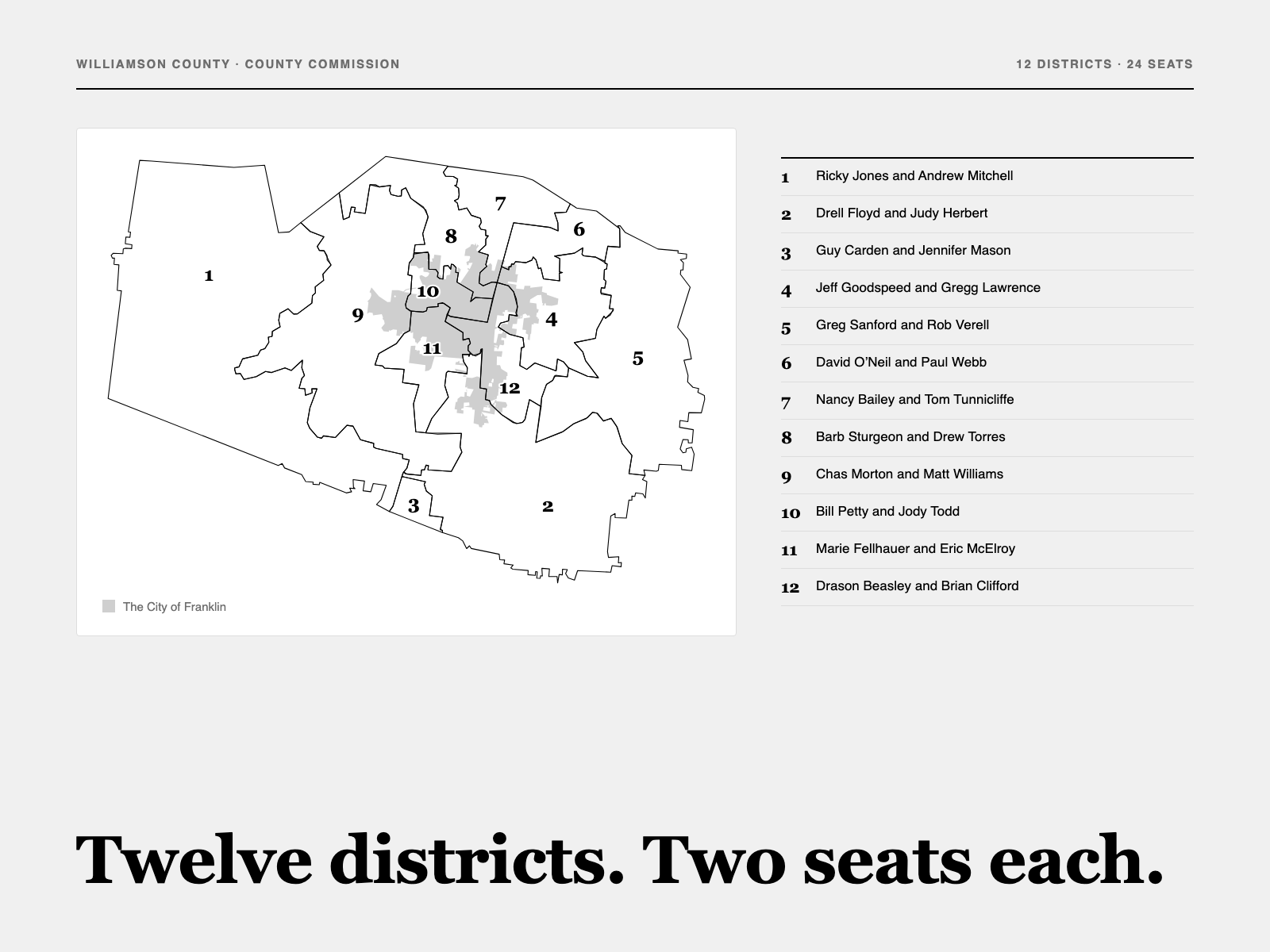
The 24 commissioners and their 12 districts, which two answer to your address, the $921.9 million budget and the tax rate they set in June, how a resolution passes with 13 votes, and how each of them voted in 2026.
A car's first registration needs new proof in January and again in July, the water and trash rates rise in January, and the city votes in October. When a step moves, this page is checked against it the same week, and the Monday email says what changed.