Common Gartersnake
Identification
The snake that shows up in March, when nothing else has come out of the ground. Its county records peak in March and April, earlier than any other species on this list.
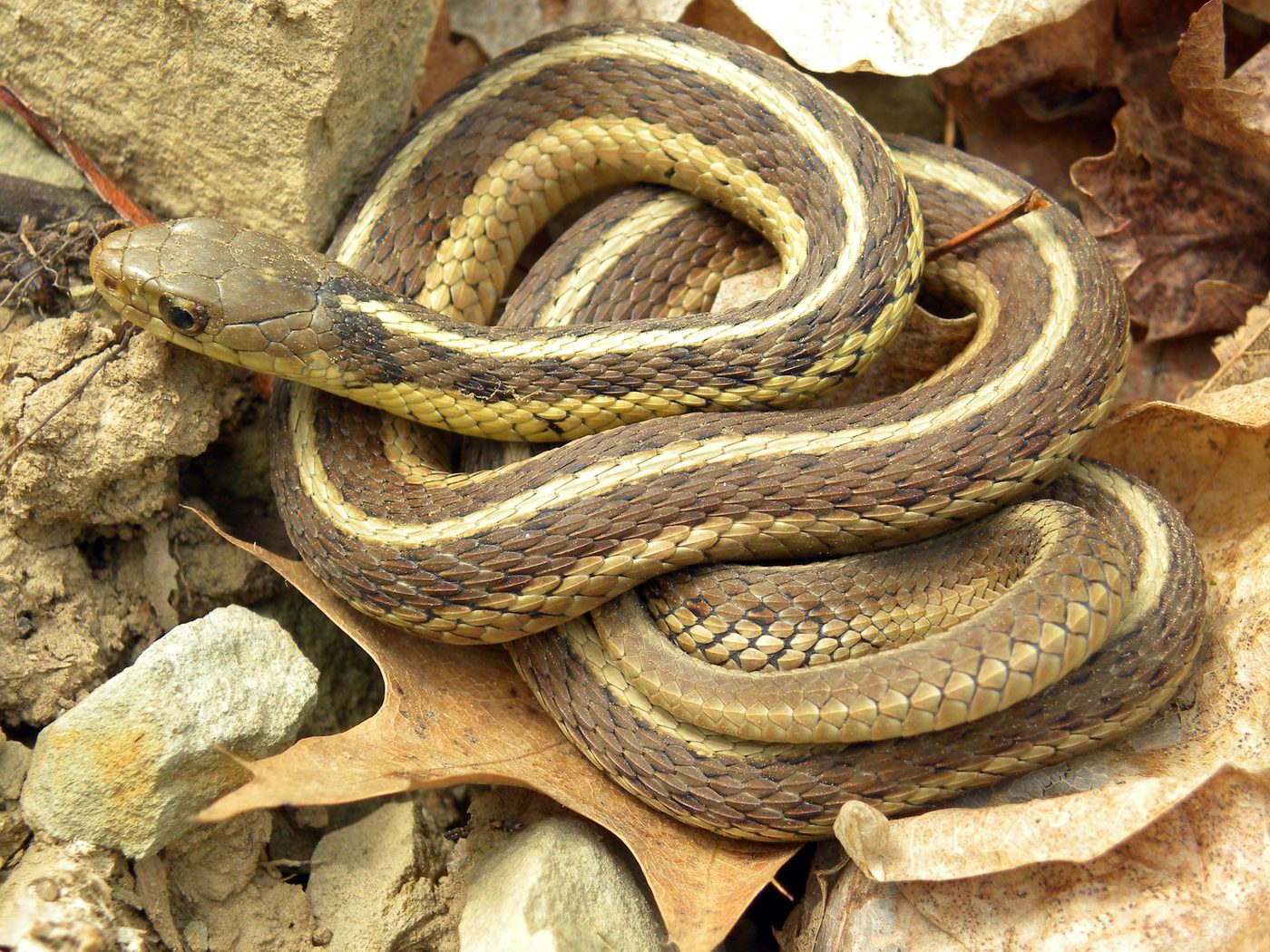
Count the stripe rows if you want to be certain. A gartersnake's side stripes sit on scale rows two and three, counting up from the belly. A ribbonsnake's sit one row higher. It sounds fussy until you need to tell two grass-colored snakes apart in a hurry.
Where to expect it.
County-wide and at home in town. This is the snake in the raised bed.
Active Season
Charted from this species’ own research-grade records inside Williamson County.
What it gets mistaken for.
Three striped snakes live in this county and they sort out cleanly once you know where the stripes sit.
The ribbonsnake is markedly slimmer with a very long tail, about a third of its total length, and its side stripes sit on scale rows three and four. It also has no black markings on the lower jaw.
A queensnake has no stripe down the center of the back and a yellow belly ruled with four brown lines. It also does not leave the water for long.
The brownsnake has no light side stripes at all, just two parallel rows of dark spots down a brown back.
When you meet one.
It will try to leave. If cornered it flattens, may strike with a closed mouth, and empties a musk gland that does not wash off easily.
Leave it.
It is working through slugs and frogs. It is the least disruptive lodger available.
Lift from the far side.
Most garter bites happen because a hand arrived before an eye did. Move the pot, then look.
Good news.
This is the harmless snake children in Middle Tennessee are most likely to pick up. Teach the stripe check, then teach the wash-your-hands rule.
Bucket and board.
Drop a bucket over it, slide a sheet of card underneath, carry it to the treeline. It cannot climb out of a smooth-sided bucket.
Pack it. Print it. Pass it on.
Most snakes killed in Williamson County are killed by someone who could not name them. Send this to anyone who gardens, hikes, keeps a woodpile, walks a dog off the greenway, or has a teenager who reaches into things. That is most of the county.
Sources
Medical disclaimer. This field guide is general educational information, not medical advice, and is no substitute for professional diagnosis or treatment. Any bite from a copperhead or a timber rattlesnake is a medical emergency: go to an emergency department, and call the Tennessee Poison Center at 1-800-222-1222 on the way. In an emergency, call 911. Identification disclaimer. No photograph identifies a snake with certainty, and this guide will not make anyone a herpetologist. When the answer matters, keep your distance and send a photograph to someone who does this for a living.