Plain-bellied Watersnake
Identification
The watersnake that leaves the water. Adults travel well overland between wetlands, which puts a large, dark, heavy snake in places nobody expects a watersnake and gets it killed as a cottonmouth.
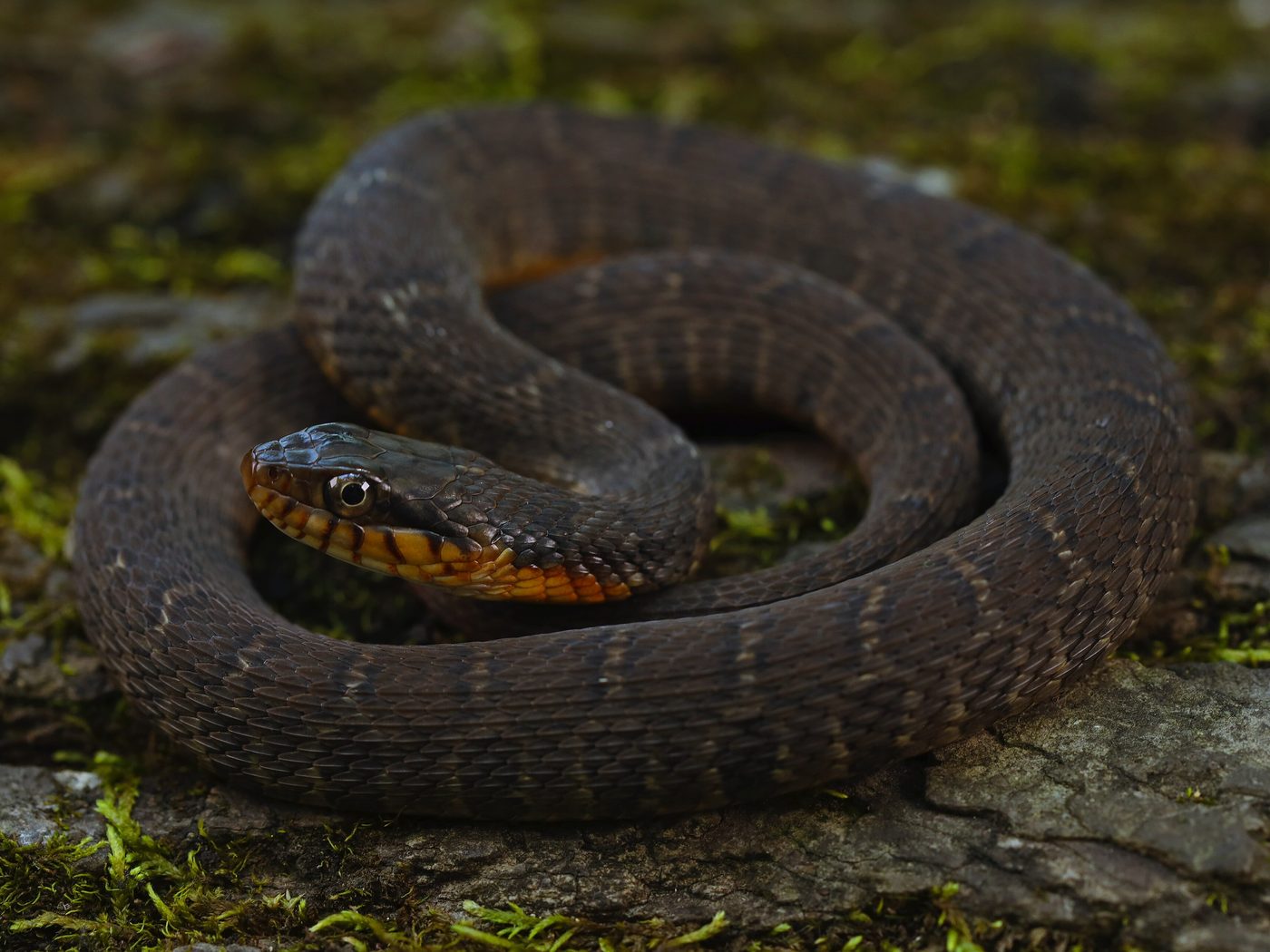
The copper-bellied form, which occupies the lower Cumberland and Tennessee River watersheds of Middle Tennessee, is rated rare to very rare and vulnerable to extirpation by the Tennessee Department of Environment and Conservation. A killed adult in this county is a meaningful loss.
Where to expect it.
The lower Cumberland and Tennessee River watersheds; Williamson County sits at the margin.
Active Season
Too few county records to chart. This is the species’ typical season, from TWRA.
What it gets mistaken for.
A big dark snake crossing a road away from water is read as a cottonmouth by almost everyone. It is almost never a cottonmouth.
No facial pit, a round pupil, and no broad dark band from snout through eye. Range rules it out before the animal does.
A northern watersnake keeps a patterned belly with rows of half-moons and dark markings the length of the body. This one goes plain with age, above and below.
Smooth, glossy scales and a slim build. The plain-bellied watersnake is keeled, matte and heavy.
When you meet one.
On land it is slow, conspicuous and defensive. It will flatten, strike and bite, and it has nothing behind any of it.
Let it cross.
Road mortality is the main pressure on this species in Middle Tennessee. Wait the ten seconds.
It is passing through.
Overland travel between wetlands is normal for this animal. It is not setting up residence.
Check the belly.
Plain yellow or plain orange underneath, no dark eye band, round pupil. That is a watersnake.
No venom, but it bleeds.
Watersnake saliva thins blood, so the wound runs. Wash, press, and treat it as a puncture.
Pack it. Print it. Pass it on.
Most snakes killed in Williamson County are killed by someone who could not name them. Send this to anyone who gardens, hikes, keeps a woodpile, walks a dog off the greenway, or has a teenager who reaches into things. That is most of the county.
Sources
Medical disclaimer. This field guide is general educational information, not medical advice, and is no substitute for professional diagnosis or treatment. Any bite from a copperhead or a timber rattlesnake is a medical emergency: go to an emergency department, and call the Tennessee Poison Center at 1-800-222-1222 on the way. In an emergency, call 911. Identification disclaimer. No photograph identifies a snake with certainty, and this guide will not make anyone a herpetologist. When the answer matters, keep your distance and send a photograph to someone who does this for a living.