Prairie Kingsnake
Identification
A blotched grassland kingsnake that spends much of its life underground in rodent burrows, which is why two county records understates it badly. TWRA notes plainly that it is often misidentified as a copperhead and needlessly killed.
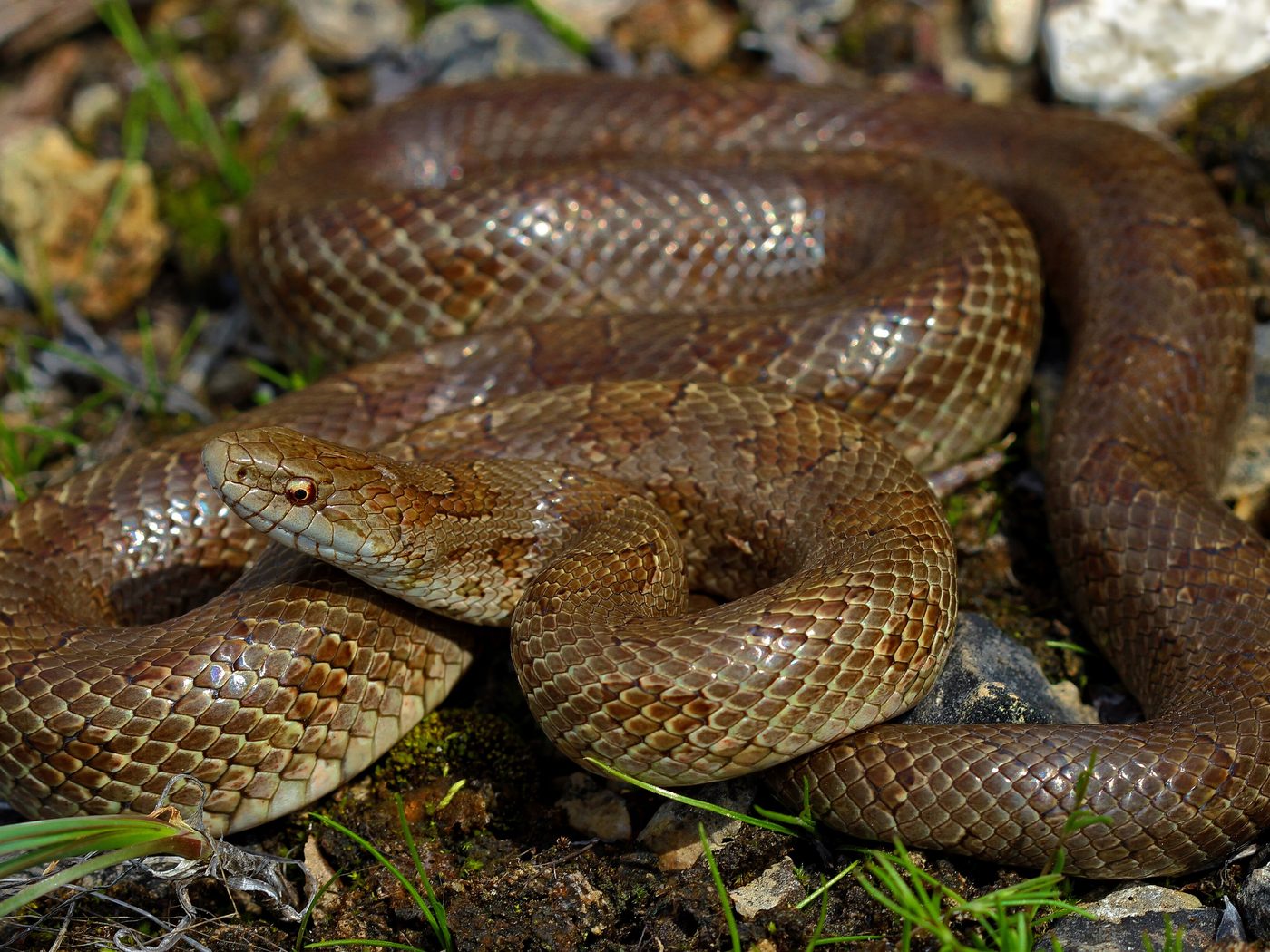
A snake that lives in the tunnels it hunts is a snake nobody counts. Prairie kingsnakes surface to move and to breed, so almost every record anywhere is a road crossing or a turned board.
Where to expect it.
Grassland and farm ground, which in this county means the eastern half.
Active Season
Too few county records to chart. This is the species’ typical season, from TWRA.
What it gets mistaken for.
Blotched, tan, and in a field. That combination gets a lot of harmless snakes killed in this county.
Blotches widest across the spine and rounded, a plain arrowhead on the crown rather than a solid copper head, and smooth, shiny scales rather than keeled ones.
A milksnake's blotches are larger, closer together and ringed in black, over a belly checkered in black and white rather than brown.
Keeled scales and a loaf-shaped cross-section. This one is round and glossy.
When you meet one.
It vibrates its tail, may strike, and gives up quickly. No venom and no real bite.
Let it cross.
Almost every sighting is a road crossing, and almost every death is too.
Leave it.
A snake specializing in voles and mice on agricultural ground is doing unpaid work.
Photograph the head.
The arrowhead on the crown and the brown-checked belly are the two marks that settle it against a copperhead.
Put the board back.
Sheet cover on field edges is how this species is found at all. Replace it as you found it.
Pack it. Print it. Pass it on.
Most snakes killed in Williamson County are killed by someone who could not name them. Send this to anyone who gardens, hikes, keeps a woodpile, walks a dog off the greenway, or has a teenager who reaches into things. That is most of the county.
Sources
Medical disclaimer. This field guide is general educational information, not medical advice, and is no substitute for professional diagnosis or treatment. Any bite from a copperhead or a timber rattlesnake is a medical emergency: go to an emergency department, and call the Tennessee Poison Center at 1-800-222-1222 on the way. In an emergency, call 911. Identification disclaimer. No photograph identifies a snake with certainty, and this guide will not make anyone a herpetologist. When the answer matters, keep your distance and send a photograph to someone who does this for a living.