Blacklegged Tick
Identification
The single most medically important tick in the United States. Carries the bacterium responsible for Lyme disease and four other illnesses, and its nymphal stage is small enough to feed unnoticed for days.

Adults are active even at near-freezing temperatures. If the ground is not frozen and the deer are moving, the blacklegged tick is moving with them.
Where to find it.
Northeast from Maine to Virginia, the Upper Midwest from Wisconsin into Minnesota, and increasingly the Ohio Valley.
Distribution Map
Source · CDC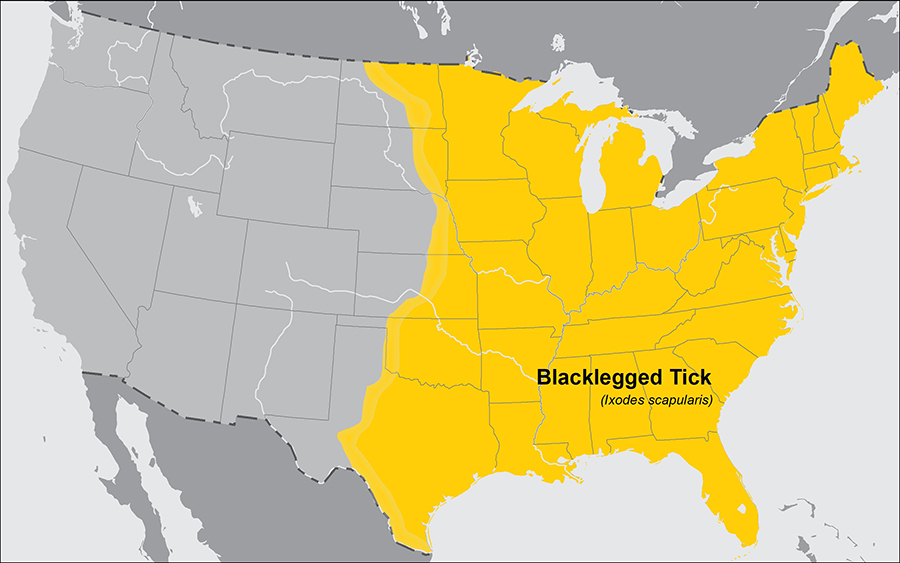
Active Season
When this species is questing for hosts. Peak months in red are the highest-risk windows.
If it bit you.
A bite from this species carries a specific set of risks. The timeline below tells you what to watch for and when to act.
A bite from this tick that lasts more than 24 hours is the single highest-risk event for contracting Lyme disease in the United States. The longer it feeds, the higher the transmission rate climbs.
Negligible Lyme risk.
Lyme transmission is rare before 24 hours of attachment. Remove the tick now and you have likely avoided the disease entirely.
Transmission window opens.
Lyme risk rises sharply between hours 36 and 48. Powassan virus, however, can transmit in as little as 15 minutes.
Erythema migrans.
The expanding bullseye rash appears in 70 to 80 percent of Lyme cases, often with fever, chills, and headache. Photograph it.
Joint and neurological signs.
Untreated Lyme can progress to joint swelling, Bell's palsy, irregular heart rhythm. Babesiosis can incubate four weeks.
Diseases This Species Carries
For the general post-bite protocol, visit the Bitten page.
Gear for blacklegged tick country.
The four products that matter most when this species is the one you are likely to encounter.

Permethrin Spray
The one item that matters most in blacklegged country. Treat hiking pants, socks, and boots before any wooded outing.
Shop →
Wondercide Insect Repellent
Essential-oil repellent with no DEET. Spray ankles, neck, and behind the knees; reapply every couple of hours and after sweating.
Shop →
Fine-Tip Tweezers
Standard tweezers are too thick to grip a nymph close to the skin. Pointed tips are required.
Shop →
Tick Testing Kit
Mail-in PCR testing identifies whether the tick that bit you carried Borrelia burgdorferi.
Shop →Pack it. Print it. Pass it on.
The most-affected people are the least-informed. Forward this guide to anyone who hikes, hunts, gardens, owns a dog, has a child, or lives east of the Rockies. That covers most of the country.
Trusted Sources
Medical disclaimer. This field guide is general educational information, not medical advice, and is not a substitute for professional diagnosis or treatment. Tick-borne illness can be serious. If you develop a rash, fever, aches, or other symptoms after a bite, or if you are unsure, contact a healthcare provider promptly. In an emergency, call 911. Affiliate disclosure. Some product links in this guide are affiliate links; we may earn a small commission at no additional cost to you.