25%
Of a home's appraised value is taxed
How Franklin works · Property tax
Every property tax bill in Williamson County is the same short sum: the Assessor's value, a quarter of it, and a rate from each government the house sits inside. Which governments those are depends on where the house sits, so two Franklin houses with the same value can owe bills $1,642 apart. How the sum works, the rate in every town in the county, when the bill is due, and what to do if the value looks wrong.
A property tax bill in Williamson County comes from three numbers. The Assessor of Property puts a value on the house. State law taxes a quarter of that value for a home, and that quarter is called the assessed value. Then every government the house sits inside charges a rate on each $100 of assessed value: the county on every house, a city on a house inside one, and the Franklin Special School District on a house inside its boundary.
Take a house the Assessor appraises at $970,000, the median Franklin sale in our Franklin guide. Its assessed value is $242,500. Outside the FSSD it pays the county $1.27 and the city $0.296 per $100 of that, about $3,798 a year. Move the same house across the district line and the county's rate drops to $1.18 while the district adds $0.7673, for about $5,440. Same value, same city, $1,642 apart.
So the first question about any bill is which zone the house is in, and that is a line on a map. A Franklin mailing address can sit inside the city limits or outside them, and inside the FSSD or outside it. The Assessor's value is the one part of the bill an owner can contest, and only for a few weeks each May and June. The rates are set by elected bodies in June, and in Franklin all of it is billed by one office, the Williamson County Trustee.
These are the rates for tax year 2026, the bills mailed this month, per $100 of assessed value, from the county's rate sheet. The combined column is the number to multiply by.
| Where the house is | County | City | FSSD | Combined |
|---|---|---|---|---|
| Franklin, outside the FSSD | $1.27 | $0.296 | None | $1.566 |
| Franklin, inside the FSSD | $1.18 | $0.296 | $0.7673 | $2.2433 |
| The FSSD, outside the Franklin city limits | $1.21 | None | $0.7673 | $1.9773 |
| Unincorporated Williamson County | $1.30 | None | None | $1.30 |
| Brentwood | $1.30 | $0.19 | None | $1.49 |
| Fairview | $1.30 | $0.8404 | None | $2.1404 |
| Nolensville | $1.30 | $0.34 | None | $1.64 |
| Spring Hill, Williamson County sideThe city line comes on its own bill from the city | $1.27 | $0.739 | None | $2.009 |
| Thompson's Station | $1.30 | $0.103 | None | $1.403 |
Per $100 of assessed value, tax year 2026. Source: Williamson County, 2026 property tax rates. The Maury County side of Spring Hill is on another county's rate sheet; our Spring Hill guide has both sides.
The county's own rate is lower in three kinds of zone because lines drop off its levy. Inside Franklin and Spring Hill, the county does not charge its 3-cent solid waste and sanitation line. Inside the FSSD it does not charge its 9-cent rural debt service line. Inside Franklin and the FSSD together, both drop, which is how $1.30 becomes $1.18. In Brentwood, Fairview, Nolensville and Thompson's Station the county charges every line.
The FSSD is the zone people miss. It is a separate school district for kindergarten through eighth grade, with its own board and its own tax, and its boundary, fixed by the General Assembly in 1987 at the city limits as they stood in September 1986, does not follow today's city limits: most of central Franklin is inside it, newer parts of the city are not, and some land outside the city is. The district's map page has an address lookup. The county's school system, Williamson County Schools, covers everything else, and every house in the county pays toward it through the county rate.
Put in the appraised value from your assessment notice or the Assessor's property search, which is not the same as what the house would sell for, and pick the zone. The estimate uses the 2026 rates above and rounds to the dollar. It does not know about tax relief or a freeze, and it leaves out anything on a utility bill.
The house above is the $970,000 example, in Franklin outside the FSSD.
Seven bodies have a hand in the bill. The one people call first, the Assessor's office, neither sets the rate nor sends the bill.
| Office | What it does |
|---|---|
| Assessor of PropertyBrad Coleman, elected to a four-year term. (615) 790-5727 | Puts a value on every parcel, mails a notice in May when a value changes, and reviews a value informally on request. Does not set rates, send bills or collect tax. |
| Williamson County Commission24 commissioners, two from each of 12 districts | Sets the county rate with the county budget each June. It kept $1.30 for 2026 on June 18, by a vote of 17 to 3. |
| Franklin Board of Mayor and Aldermen | Sets the city rate with the city budget, over three readings from late May through June. It kept $0.296 for 2026. |
| Franklin Special School District boardSix members, elected at large | Sets the district's rate by majority vote each July, up to the ceiling in the private act that is its charter, and certifies it to the Trustee. It set $0.7673 for 2026 on July 13, by a vote of 4 to 0. |
| Tennessee General Assembly | Wrote the FSSD's charter, tax ceiling included, and fixed its boundary, by private act. |
| Williamson County TrusteeKaren Paris, elected | Bills and collects the county and FSSD taxes and the city taxes of Brentwood, Fairview, Franklin, Nolensville and Thompson's Station. Spring Hill bills its own. The Trustee has no power to waive any part of a bill or its interest. |
| County Board of EqualizationFive members | Hears appeals of the Assessor's values each June. |
The rate sheet splits the county's rate into funds, so a bill can be read line by line. This is the $3,798 bill on the $970,000 house in Franklin, outside the FSSD.
Bars scale to the largest line. Rates per $100 of assessed value, tax year 2026, on an assessed value of $242,500. The county's highway line has been zero since 2018.
Nearly half of that bill, 77 cents of every $1.566, is the county's general purpose school fund. The county shares it with the FSSD by attendance: in the 2025–26 county budget, Williamson County Schools received 93.4 percent of it and the FSSD 6.6 percent. A house inside the FSSD pays the same 77 cents and the district's own 76.73 cents on top, so more than two-thirds of its bill goes to schools.
For 2026 the commission kept the county's total at $1.30 but moved two cents from the general fund, which fell from 28 cents to 26, to the school fund, which rose from 75 to 77.
The values on the roll move all at once, in a reappraisal year, when the Assessor revalues every parcel in the county. Williamson County's last reappraisal took effect in 2025; the two before it were 2021 and 2016, and the state Comptroller's schedule lists the next for 2028. In 2025 values rose about 52 percent on average, the Williamson Herald reported.
Tennessee law then has each government calculate a certified tax rate: the rate that would raise the same total as the year before from the same properties, leaving out new construction. A government may adopt a higher rate, but only after publishing notice and holding a public hearing. That is why the 2025 rate sheet reads like a tax cut. The county's rate fell from $1.88 to $1.30, and Franklin's from $0.3261 to $0.296.
Both were set above the certified rate. The commission adopted $1.30 on June 20, 2025, against a certified rate the Williamson Scene reported as $1.2433. Franklin's aldermen adopted $0.296 against a certified $0.2310, on a 5 to 2 vote. Here is what that did to a Franklin house outside the FSSD whose appraisal rose by the county average:
| Tax year | Appraised | Assessed | County + city rate | Bill |
|---|---|---|---|---|
| 2024 | $640,000 | $160,000 | $1.83 + $0.3261 | $3,450 |
| 2025 | $972,800 | $243,200 | $1.27 + $0.296 | $3,809 |
A 52 percent rise in appraisal. The combined rate fell 27 percent; the bill rose $359, about 10 percent. Inside Franklin the county's share was $1.83 in 2024, not the $1.88 charged outside the cities.
A house whose value rose less than the average came out ahead, and one whose value rose more paid more. 2026 was not a reappraisal year, so values stayed where they were and the county and city held their rates. The FSSD's rate went the other way. On July 13 the district's board raised it 18 cents, from $0.5873 to $0.7673, an increase of about 31 percent. All of it is in the general purpose line, which went from $0.4323 to $0.6123; the debt service line held at $0.1550. The rise adds about $437 this year to the $970,000 house inside the district.
The tax year runs on the calendar year, and the bill for it arrives near the end. The 2026 bill, mailed this month, follows this path.
The value is the one part of the bill an owner can contest, and the window opens with the May notice and closes in June. The Assessor's office will look at a value informally, but an informal review does not preserve the right to appeal. That takes an appointment with the County Board of Equalization, booked through the Assessor's office at (615) 790-5708; in 2026 the deadline was June 11. A value nobody appeals to the county board becomes final for the year.
The board decides what the property is worth, so the case is evidence of value as of the reappraisal: sales of similar houses nearby, an independent appraisal, or a fault in the Assessor's record of the house, such as square footage it does not have. The board cannot touch the rate. An owner who loses can go on to the State Board of Equalization by August 1, or within 45 days of the county board's decision if that is later, for a hearing before an administrative judge.
The Trustee cannot help with any of this. Its office bills what the roll and the rates add up to, and state law gives it no power to reduce a bill or forgive interest.
Tennessee's tax relief program pays part of the bill for homeowners who are 65 or older, or totally and permanently disabled, with a 2025 income of $38,470 or less, and for qualifying disabled veterans. It is a reimbursement, not an exemption, figured on the first $33,600 of the home's market value, or the first $175,000 for a veteran. In Franklin that comes to less than $200 a year, or less than $1,000 for a veteran.
The county also runs the state's optional tax freeze for homeowners 65 and older with a 2025 income of $69,150 or less. It holds the county tax on the home at its amount in the year the owner qualifies, even as the rate or the value rises later, and it does not cover more than five acres. Franklin has not adopted the freeze for its city tax; Spring Hill has adopted one for its own. Both programs are applied for after paying: for the 2026 bill, by April 5, 2027, with the taxes paid in full. Franklin waives its monthly trash fee for households in the state relief program.
Farm and forest land of 15 acres or more, and open space of 3 acres or more, can be taxed on its use rather than its market value under the greenbelt program, by application to the Assessor by March 15. Taking land out of greenbelt brings a rollback bill for the tax it saved over the previous three years, or five for open space.
The Trustee takes partial payments, so a bill can be paid down over the winter. Online, through the Trustee's payment portal, a card costs 2.75 percent of the payment (at least $1.50) and a bank draft $1.50; by phone, at (855) 748-2268, the fee is 95 cents. Checks go by mail or in the drop box, and the office takes cash, checks and cards at 1320 West Main Street, Suite 203, in the county's administrative complex. If a mortgage lender pays from escrow, the bill that arrives in October is a copy for your records.
Every rate on this page is from the county's 2026 rate sheet, read line by line; the worked examples are our arithmetic on those rates, rounded to the dollar at the end. Where a news report is the only source, as for the certified rates and the 2026 commission vote, the source list says so. The rates change every summer, and the stamp at the top says when we last checked them.
Next
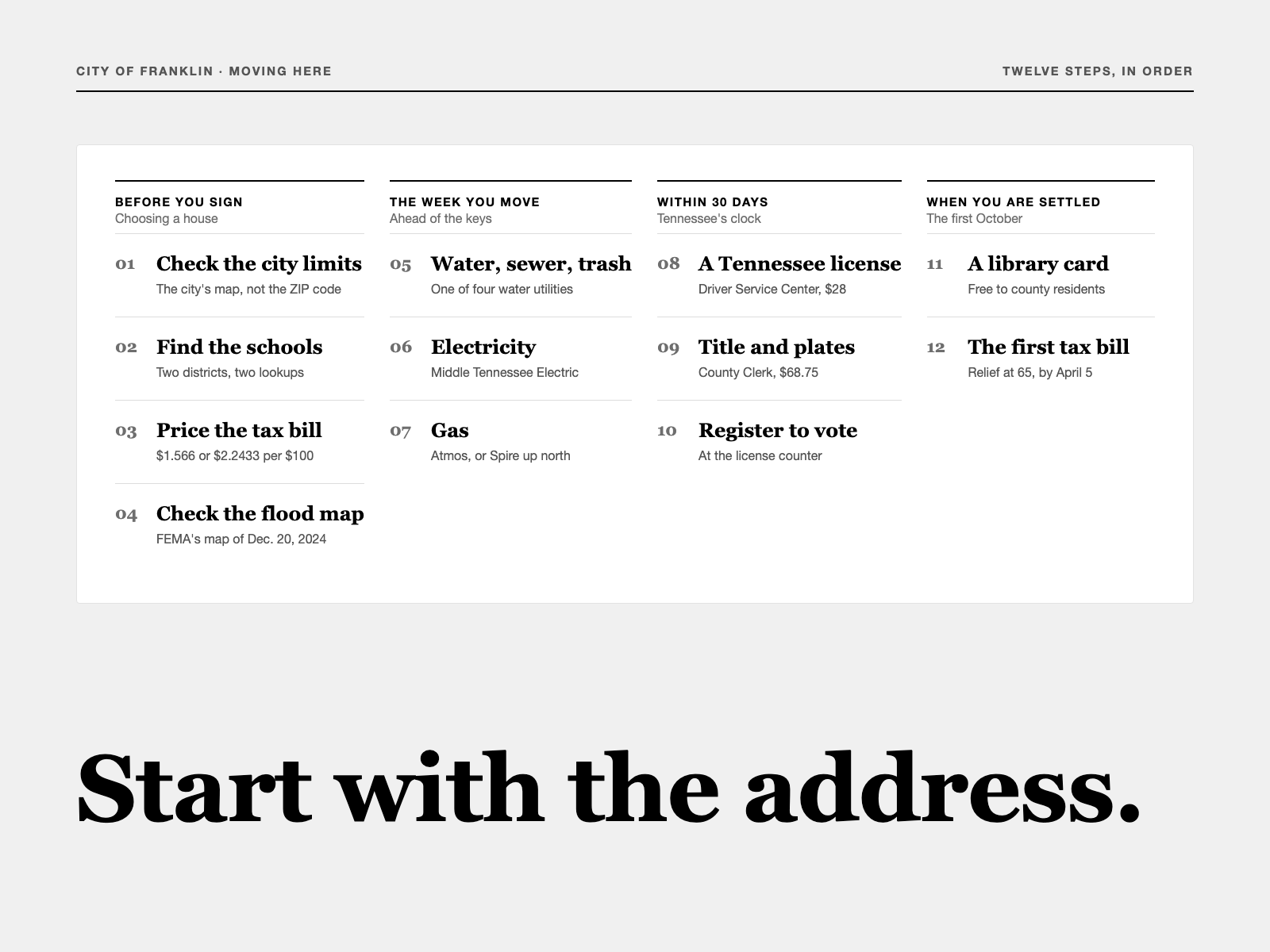
Twelve steps in the order they fall due: what to check before signing, what to start the week you move, and the 30-day clock on a license, plates and a voter registration.
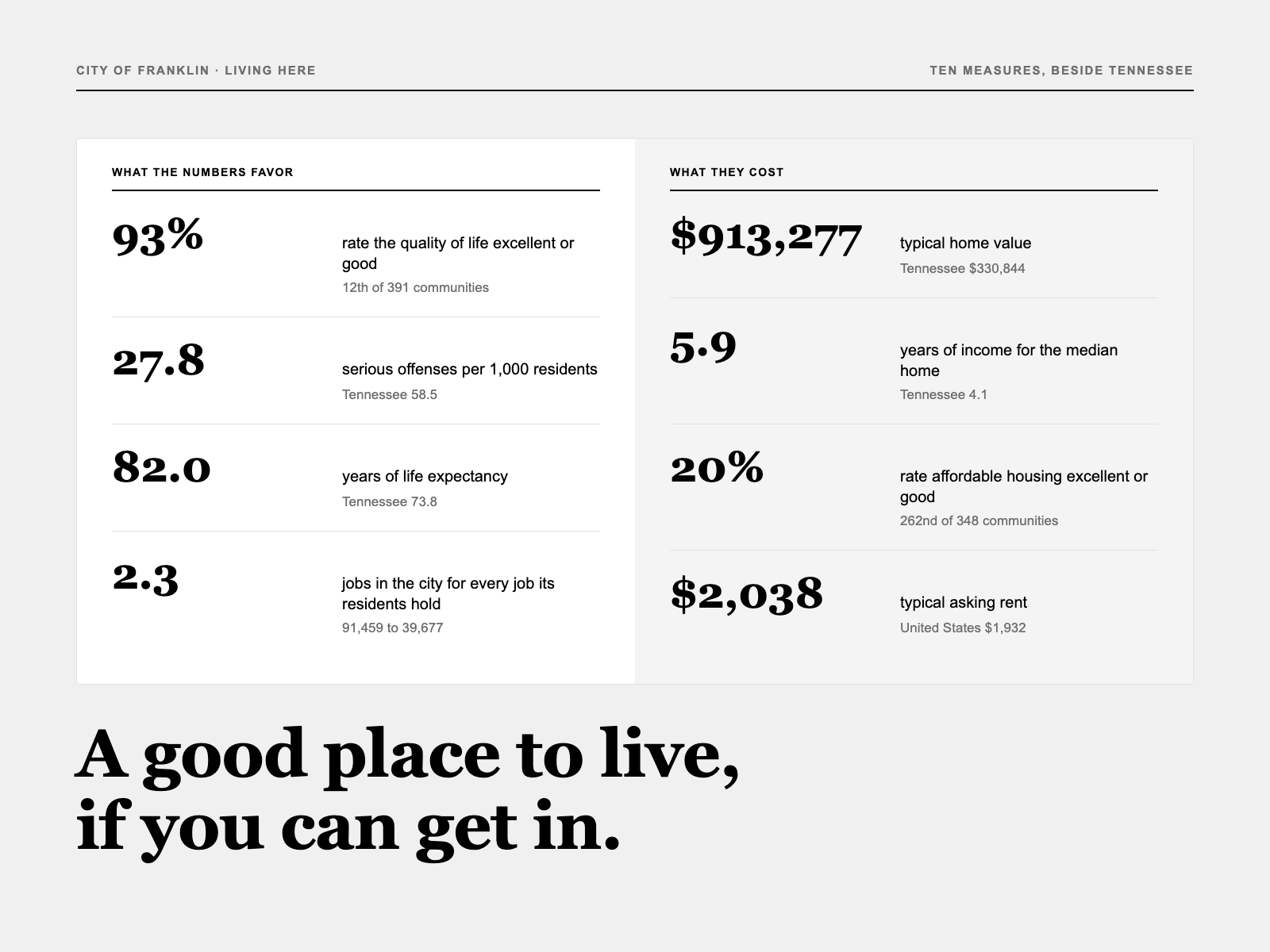
What residents say in the city's own survey, then the figures for cost, schools, crime, health, jobs, commuting, weather and the river, each beside the state's, and which households carry the costs.
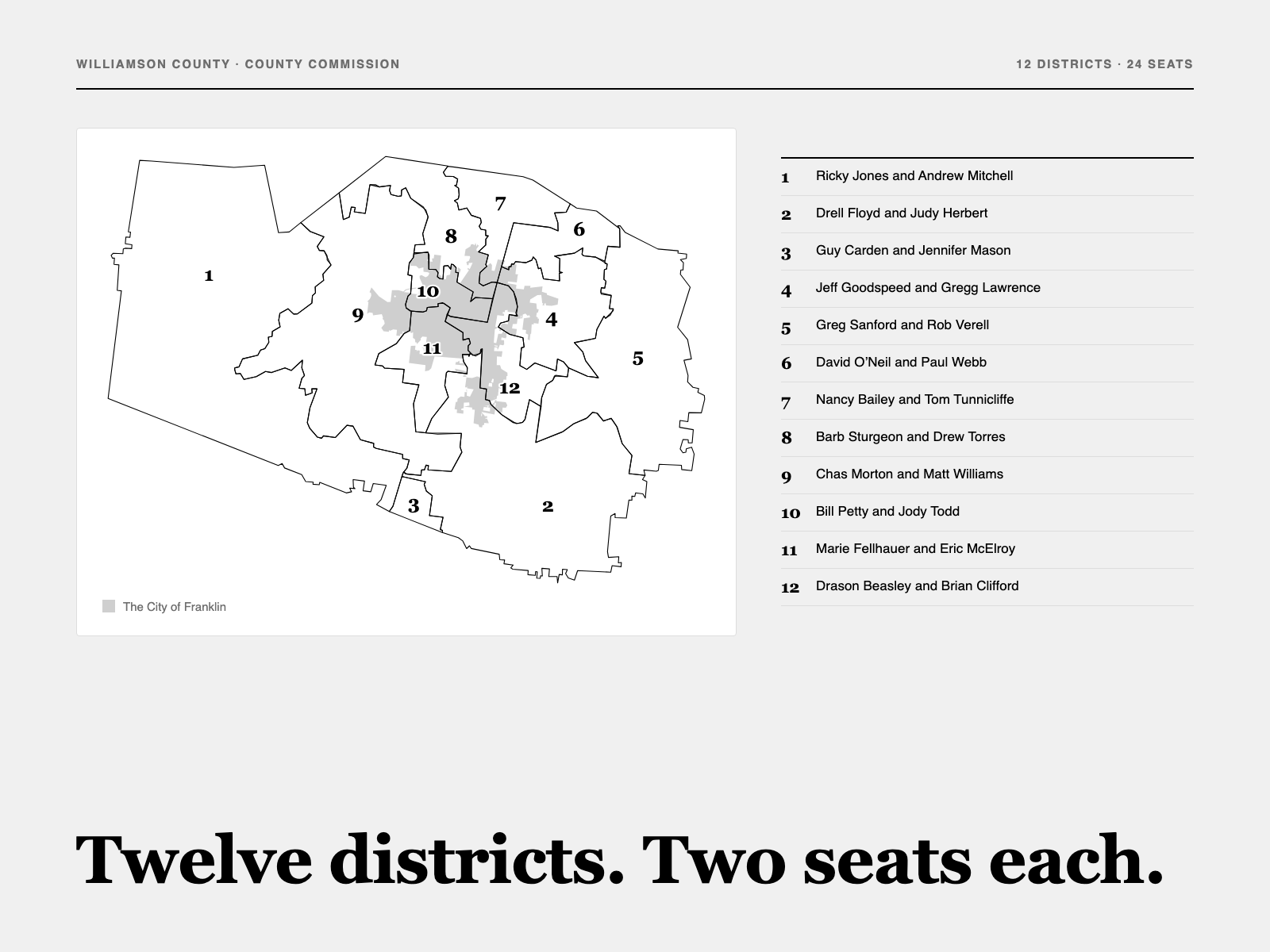
The 24 commissioners and their 12 districts, which two answer to your address, the $921.9 million budget and the tax rate they set in June, how a resolution passes with 13 votes, and how each of them voted in 2026.
The county commission and Franklin's aldermen settle the next bill in a handful of budget meetings. We read the budgets and the rate sheets, and send the plain-English version of what changed before the bill arrives.