$148.90
A 6,000-gallon month on city water, 2026
How Franklin works · Water bill
A Franklin utility bill is four charges set by one board: water and sewer by the gallon, stormwater and trash by the month. The sewer charge counts the water that went on the lawn, all four rise every January under ordinances already passed, and more than a third of the city's utility customers buy their water from someone else. How the bill is figured, what the new rates add, and what to do when it comes in high.
A City of Franklin utility bill carries up to four charges: water, sewer, stormwater, and trash and recycling. The Board of Mayor and Aldermen sets all four. Water and sewer follow the meter, with a minimum that covers the first 1,000 gallons and a price for each 1,000 after it. Stormwater and trash are flat monthly fees on every home inside the city limits.
Take a house inside the city, on city water, that used 6,000 gallons last month, the amount the city's rate consultants use to compare Franklin's bills with its neighbors'. Water comes to $50.58 and sewer to $62.45; add $2.87 for stormwater and $33 for one trash cart, and the month costs $148.90. On January 1 all four lines go up under ordinances already passed, and the same month will cost $157.93.
The first question about any Franklin bill is who sells the water, because the city is only one of four utilities that do. Mallory Valley, Milcrofton and HB&TS are utility districts, each a separate public utility with its own board and its own rates, and between them they serve more than a third of the city's utility customers, Cool Springs and Westhaven among them. Those households pay their district for water and the city for everything else, with the sewer charge figured from the district's meter. Everything below about the city's bill applies to them except the water line.
Inside Franklin's city limits, water comes from one of four utilities. The city says so on its rates page, and its address map, My Government Services, which also gives an address's trash and recycling days, carries a layer of the four utilities' territories. Mallory Valley's service area map draws its neighbors' lines as well.
| Utility | Where in Franklin | Water, 6,000 gallons | Due |
|---|---|---|---|
| City of Franklin(615) 794-4572 | Downtown, Fieldstone Farms, Berry Farms, Founders Pointe, Spencer Hall, River Landing | $50.58 | The "Late After" date on the bill |
| Mallory Valley Utility District(615) 628-0237 | Cool Springs, Ashton Park, the Galleria, part of McKay's Mill | $42.75 | The 1st of the month |
| Milcrofton Utility District(615) 794-5947 | Most of McKay's Mill, Avalon, Ladd Park, Lockwood Glen, Amelia Park | $59.00 | The 1st; shut off if unpaid by the 10th |
| HB&TS Utility District(615) 794-7796 | Westhaven | $72.00 | The 10th; 10% added after it |
Where: the city's Water Districts layer, whose lines were last edited in April 2017, checked against the subdivisions in the city's parcel records. Water: each utility's 2026 residential rate for 6,000 gallons on a standard meter. Mallory Valley charges $11.40 with the first 500 gallons and $5.70 for each 1,000 after; Milcrofton $20 plus $6.50 for each 1,000; HB&TS $24 plus $8.00 for each 1,000.
By our count of the parcels on the city's map, about six in ten Franklin properties are on city water, nearly two in ten on Milcrofton's, and about one in ten each on Mallory Valley's and HB&TS's. The map is a guide, not the last word. Its lines date from 2017, and Falcon Creek, for one, falls on different sides of a line on the city's map and on Mallory Valley's newer one. Near an edge, call the city's billing office, which the city names for exactly that question.
The districts set their own rates, and Franklin's aldermen have no say in them. Each is run by a board of commissioners who serve four-year terms; when a seat opens, the board names three candidates and the Williamson County mayor picks one. None of them treats water. All three buy it already treated from the Harpeth Valley Utility District, which draws it from the Cumberland River. HB&TS's board has a cost-of-service study and a rate adjustment on its October 21 agenda, so its figures above may change.
Sewer, stormwater and trash inside the city are the city's, whoever sells the water. None of the districts runs a sewer system; Mallory Valley tells its customers to call the city about sewer. The city bills a district household's sewer at the same rates as its own customers', on the gallons through the district's meter. Mallory Valley and Milcrofton used to put the city's charges on their own bills and stopped, in 2008 and 2015, so their customers get one bill from the district and one from the city. A district household moving in needs both accounts. A house on septic does not escape the sewer line either: once a city sewer runs within 200 feet of the property, the code charges it whether or not it connects.
These are the city's rates for a home inside the city limits. The first column is what this year's bills charge. The second is what they charge from January 1, 2027, under ordinances the aldermen passed in 2025 and this June.
| Line | 2026 | From Jan. 1, 2027 |
|---|---|---|
| Water, the first 1,000 gallonsThe minimum, charged in a month with no use too | $22.68 | $23.94 |
| Water, the next 9,000Each 1,000 gallons | $5.58 | $5.90 |
| Water, the next 15,000Each 1,000 gallons | $6.57 | $6.93 |
| Water, past 25,000Each 1,000 gallons | $7.55 | $7.97 |
| Sewer, the first 1,000 gallonsThe minimum, wherever the water comes from | $28.55 | $30.18 |
| Sewer, the next 14,000Each 1,000 gallons | $6.78 | $7.17 |
| Sewer, past 15,000Each 1,000 gallons | $5.94 | $6.28 |
| Stormwater, a smaller house3,350 square feet of hard surface or less | $2.87 | $4.46 |
| Stormwater, a larger houseMore than 3,350 square feet | $4.60 | $7.13 |
| Trash and recycling, one cartWeekly pickup. Each extra cart is $11 this year and $10.50 from January | $33.00 | $34.00 |
A month, for a home inside the city limits. Water and sewer: Ordinance 2025-09. Stormwater: Ordinance 2021-18, then 2026-12, which sets the unit at $5.94; January's two residential figures are the city's own for three-quarters and 1.2 times that unit. Trash: Ordinance 2024-19, then 2026-08.
Water and sewer are priced in blocks. The minimum covers the first 1,000 gallons and is charged even in a month when nothing runs. After that, water gets dearer as use climbs, from $5.58 for each 1,000 gallons to $7.55 past 25,000, which lands on the months the sprinklers run. Sewer goes the other way and gets cheaper past 15,000 gallons. The city's code bills sewer on "gallons of water delivered," every gallon through the meter, with no winter average and no cap, and the city does not adjust water or sewer bills for lawn sprinkling.
Stormwater pays for the city's stormwater utility, which its engineering department runs. The fee is counted in units of 3,350 square feet of impervious surface, the roof, driveway and patio that shed rain instead of soaking it up. A house at or under one unit pays three-quarters of the unit rate and a house over it pays 1.2 times the rate; a business pays for every unit it measures. Trash is one flat fee for a cart picked up weekly, with curbside recycling. Households enrolled in the state's property tax relief program pay nothing for it.
A home outside the city limits that is on city water or sewer pays higher rates, a $25.25 water minimum and a $33.92 sewer minimum this year, and gets no stormwater or trash line.
Put in the gallons from a recent bill and say who sells your water. The estimate uses the rates in the table above, this year's and January's, for a home inside the city. It leaves out the late penalty and the optional round-up for affordable housing.
The month above is the 6,000-gallon example: city water, a smaller house.
January's increases need no new vote. In June 2025 the aldermen set three years of water and sewer rates in one ordinance, 2025-09, which passed its third reading 7 to 0 on June 24 after a cost-of-service study by the engineering firm Hazen and Sawyer. It changes the rates on January 1 of 2026, 2027 and 2028. Stormwater and trash followed the same pattern this June: Ordinance 2026-12 sets the stormwater unit and Ordinance 2026-08 the trash fee for 2027 and 2028, each passed 7 to 0 on its first two readings and adopted on June 23.
| The 6,000-gallon month | Water | Sewer | Stormwater | Trash | A month |
|---|---|---|---|---|---|
| 2025 | $47.93 | $59.06 | $2.87 | $31.00 | $140.86 |
| 2026 | $50.58 | $62.45 | $2.87 | $33.00 | $148.90 |
| 2027 | $53.44 | $66.03 | $4.46 | $34.00 | $157.93 |
| 2028 | $56.63 | $68.88 | $4.63 | $36.00 | $166.14 |
City water, a smaller house, inside the city. 2025 at that year's rates ($21.48 and $27.01 minimums); 2028 at the rates Ordinance 2025-09 sets for that year ($25.38 and $31.48) and three-quarters of the $6.17 stormwater unit Ordinance 2026-12 sets.
The ordinance describes the steps as 6 percent a year for residential water and 5.7 percent for sewer, and on this month its tables come to about 5.6 and 5.7 percent in January. The city's budget for this year described the January step as 5 percent for water and 6 for sewer. The bill follows the ordinance's tables.
Hazen and Sawyer's slides give the reasons. The increases keep 60 days of operating cash on hand and keep the system's income at 1.3 times its debt payments. That debt is mostly the renovation of the Water Reclamation Facility, the city's sewer plant: at June 30, 2025, the water and sewer fund owed $122.6 million, $111.5 million of it for that renovation, in state revolving-fund loans repaid through 2053 and in bonds. The city is also saving toward a second sewer plant, the Southeast Clean Water Plant, which its budget expects to open around 2035 and which the study sized at 6 million gallons a day and $325 million. And the study assumed the water Franklin buys from the Harpeth Valley Utility District would cost 5 percent more each year.
Stormwater is the largest step this January. The unit goes from $3.83 to $5.94 a month, 55 percent, the first increase since July 2021 and the second since the fee began in 2004. That is about $19 more a year for a smaller house and $30 for a larger one. The aldermen also adopted five-year plans for both flat fees in June, stormwater to $6.86 a unit and trash to $40 a month by 2031, but only the 2027 and 2028 steps are law.
The city's water has two sources. It pumps water from the Harpeth River into a 114-million-gallon reservoir and treats it at its plant at 838 Lewisburg Pike, rebuilt between 2015 and 2018, which treats about 2 million gallons a day. It buys the rest, already treated, from the Harpeth Valley Utility District, which draws it from the Cumberland River, and blends the two in the pipes. The city publishes no split, but its administrator told the aldermen in September 2024 that two-thirds of the city's water came from Harpeth Valley. Add the three districts, which buy all of theirs there, and most of what comes out of a Franklin tap is Cumberland River water.
The river is the limit. The state's permit for the intake, in the version the city posts, lets the city take a fifth of the Harpeth's flow, at most 7,800 gallons a minute, and nothing when the river runs below 10 cubic feet a second or its oxygen drops too low. In a drought the mayor can declare a water shortage, and the first stage bans watering lawns with city water. The city declared one in October 2023 and again in September 2024. Both applied only to customers on city water.
The two waters are not the same. In the city's 2025 water quality report, its own treated water averaged 188 parts per million of hardness and Harpeth Valley's 98, so a house on city water can see more scale than one on district water. The report, which the city publishes every year, lists every test and records no violations for 2025.
What goes down the drain goes to the city's Water Reclamation Facility on Claude Yates Drive. A $132.9 million rebuild, the largest capital project in the city's history, raised it from 12 to 16 million gallons a day and opened in 2024; a state revolving-fund loan of about $100 million paid for much of it, and that loan is most of the debt in section 05. The plant puts its treated water back into the Harpeth under a state discharge permit that limits its phosphorus. The Harpeth Conservancy sued the city in 2014 for falling short of an earlier permit, settled in 2016, and has contested the phosphorus limit in each permit since. The current permit expires December 31, 2026, so its renewal is next.
Some of that water comes back. Franklin was the first city in Tennessee to run a reclaimed water system, a separate set of pipes that carries treated wastewater for irrigation; the aldermen made it a division of the water department in 2004. Its customers have included Westhaven, the Legends Club and Franklin High School, and it is sold at $1.17 for each 1,000 gallons with no sewer charge, about a fifth of the price of drinking water, where the pipes reach. The next plant is in design. In September a $17.6 million contract with Hazen and Sawyer to design the Southeast Clean Water Plant went before the aldermen, and in October a state loan to pay for the design: 6 million gallons a day at the Pearl Park site, with part of its output purified to refill the city's reservoir.
Sewer is the line that surprises people in a dry summer, because it is charged on the water that went onto the lawn. A house that uses 6,000 gallons indoors and puts 16,000 more on the yard in July owes $151.74 for water and $165.05 for sewer that month, against $113.03 for both in a 6,000-gallon month.
The way around it is a separate irrigation meter, which the code bills as irrigation, with no sewer charge. It brings its own minimum, $31.48 a month this year whether the sprinklers run or not, and its water costs a little more, $5.90 for each 1,000 gallons. The city's fee schedule lists $1,186 to connect one to the main and $3,244.50 for a three-quarter-inch irrigation meter. Each 1,000 gallons through it saves roughly the $6.78 sewer charge, so its minimum alone takes about 56,000 gallons of watering a year to earn back, before the fees.
The leak rule is in the customer service policy the aldermen adopted in November 2025. The city takes your average over the past 12 months, splits everything above it in half, and bills you for the average plus your half. A house that averages 6,000 gallons and runs 26,000 in a month with a leak owes $367.81 for water and sewer. Adjusted, it is billed as if it used 16,000 gallons: $241.73. If the leak was in the line from the meter to the house, an outbuilding's line or the irrigation, so the water never reached the sewer, the sewer charge drops to the average and the bill to $174.77.
The conditions: one adjustment in any 365 days (two months in a row if the leak ran across both), only on bills issued in the past 90 days, and only with proof of the repair, a receipt for the part or a plumber's receipt or signed affidavit. A new house gets none before its certificate of occupancy. The request goes through the city's online Leak Adjustment Form. Filling a pool earns one sewer-only adjustment a year, on an affidavit of the pool's size and the gallons used. Customers of Mallory Valley and HB&TS who get a leak adjustment from their water utility have their city sewer adjusted when the utility tells the city; Milcrofton customers apply to the city themselves.
To check for a leak, read the meter, use no water for two hours, and read it again. If it moved, something is running. A running toilet is a common one, and the city's conservation page puts a leaky toilet at up to 200 gallons a day. The city is replacing its meters with Sensus smart meters that report hourly; it has installed 8,000 so far and says it will try to warn customers when it sees unusually high use. Its policy adds that a missing warning does not excuse the bill, and we found no portal where a customer can see the hourly readings.
If the bill still looks wrong, the policy sets the path. A customer service representative reviews the usage first. After that the dispute goes in writing to the Water Management Department, then to the city administrator or an assistant city administrator, and last to the Board of Mayor and Aldermen, whose decision is final. While it is open you owe only the part you are not disputing. You can also ask for the meter to be tested; if it reads within 2 percent, or low, you pay for the test.
The city reads meters and bills monthly, in arrears, so a bill covers the month before it. It mails or emails the bill about 15 days before the due date. The bill shows two amounts: the net amount, due by the date marked "Late After," and the gross amount, with 10 percent added, owed after it. On the $148.90 month the penalty is $14.89. The city's rate sheet says the penalty applies to every line but trash, which would make it $11.59; the trash chapter of the city code applies it to trash too.
A bill left unpaid can mean a shutoff, and the city's own documents disagree on when. Its billing web page says service may be cut off ten days after the "Late After" date, the city code says 15 days, and the customer service policy says 30 days delinquent. The policy also says the city will not start shutoffs when the daytime temperature is below freezing. A customer who will be short can ask for a payment plan before the cutoff date, a down payment and a signed note for the rest over three, six or twelve months; miss a payment and the account loses the option for a year. Turning water back on costs $35 during business hours and $75 after them. A household with a doctor's letter saying someone relies on running water for medical reasons can be flagged so the city takes special care to keep it on, though the bill is still owed.
Ways to pay:
Paperless billing is free; about 40 percent of customers use it. An optional box on the application rounds each bill up to the next dollar, and the city puts the difference toward its affordable housing program.
Starting city service takes an application, a copy of a photo ID and a $50 application fee, which can go on the first bill. There is no deposit; the code says the fee is not one. A renter also needs a copy of the lease signed by the landlord and listing every tenant, and the names on the application have to match it. Unpaid city utility bills from a previous address follow the customer to the new one. The billing office asks for at least 24 hours' notice by phone; the policy and the application form ask for three business days. The first bill arrives 30 to 45 days after the connection.
Stopping service has to be in writing, by the city's termination form, email, fax or in person, three business days ahead, and the city does not disconnect on Fridays. The code is explicit that a phone call will not do it, even though the billing FAQ tells customers to call. Name an address for the final bill; if it goes unpaid for 60 days and you have another city account, it moves onto that one. A move from one Franklin address to another needs a new application and another $50. A seasonal shutoff, for a house that will sit empty, costs $25 and keeps the account open, with the minimum charged each month.
For a house on another utility's water, start and stop the water with that utility and the sewer, stormwater and trash with the city.
The numbers: utility billing, (615) 794-4572 or utilitybilling@franklintn.gov, weekdays 8 to 5. Leaks, main breaks and low pressure on city water, the Water Management Department at (615) 794-4554, weekdays 7 to 4, and (615) 791-3260 after hours. Trash and recycling, (615) 794-1516.
Every city rate on this page is from the city's 2026 rate schedule, a scanned sheet read line by line, and from the ordinances behind it, which also set the January 2027 rates; the worked months are our arithmetic on those rates, to the cent. The districts' rates are from each district's own rate page. Where only a news report gives a figure, as for the split between the city's two water sources, the list says so. The city's map of the four utilities' territories is from 2017, and our count of how many properties each serves is our own, from that map and the city's parcel records. The rates change every January, and the stamp at the top says when we last checked them.
Next
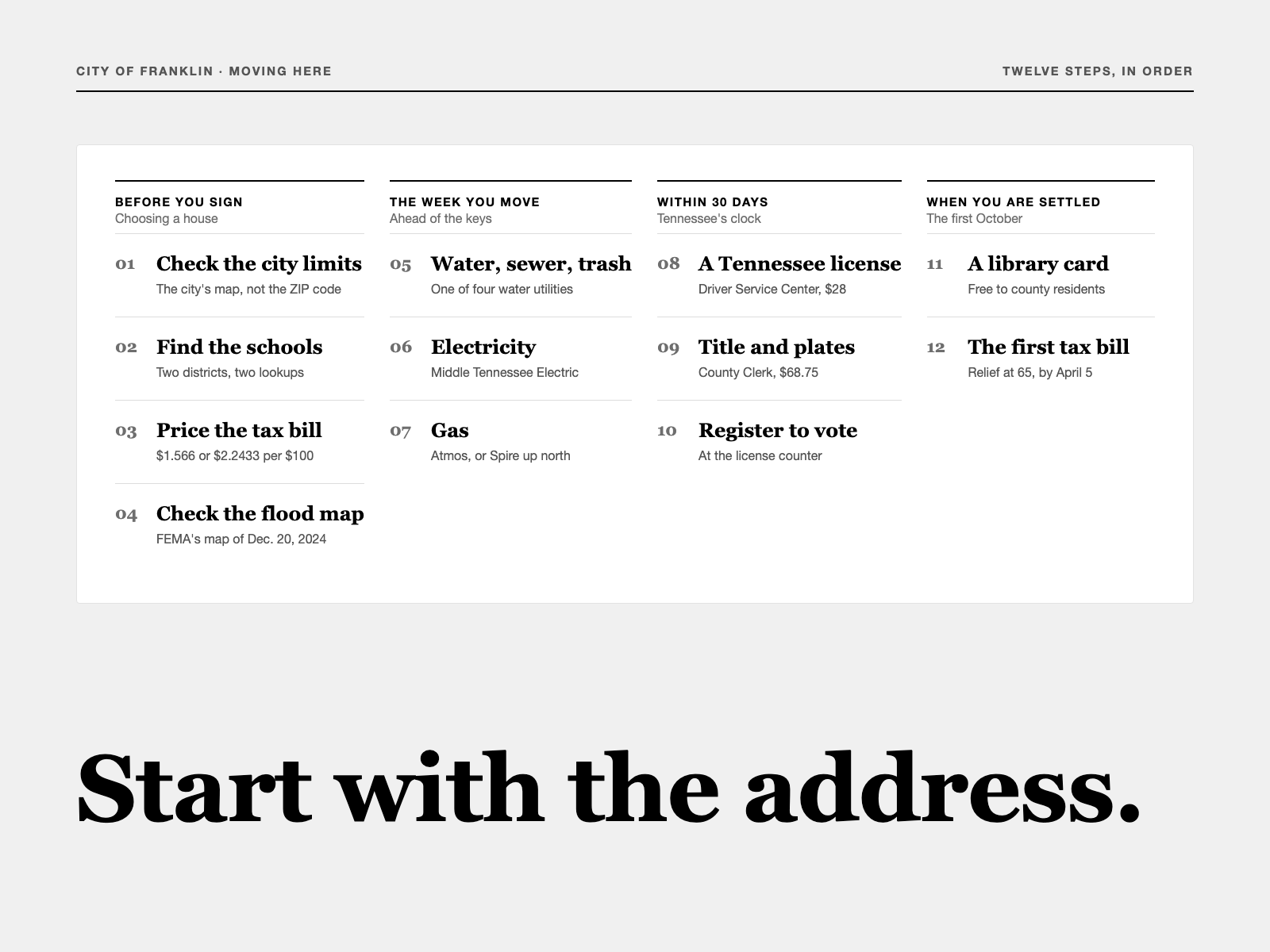
Twelve steps in the order they fall due: what to check before signing, what to start the week you move, and the 30-day clock on a license, plates and a voter registration.
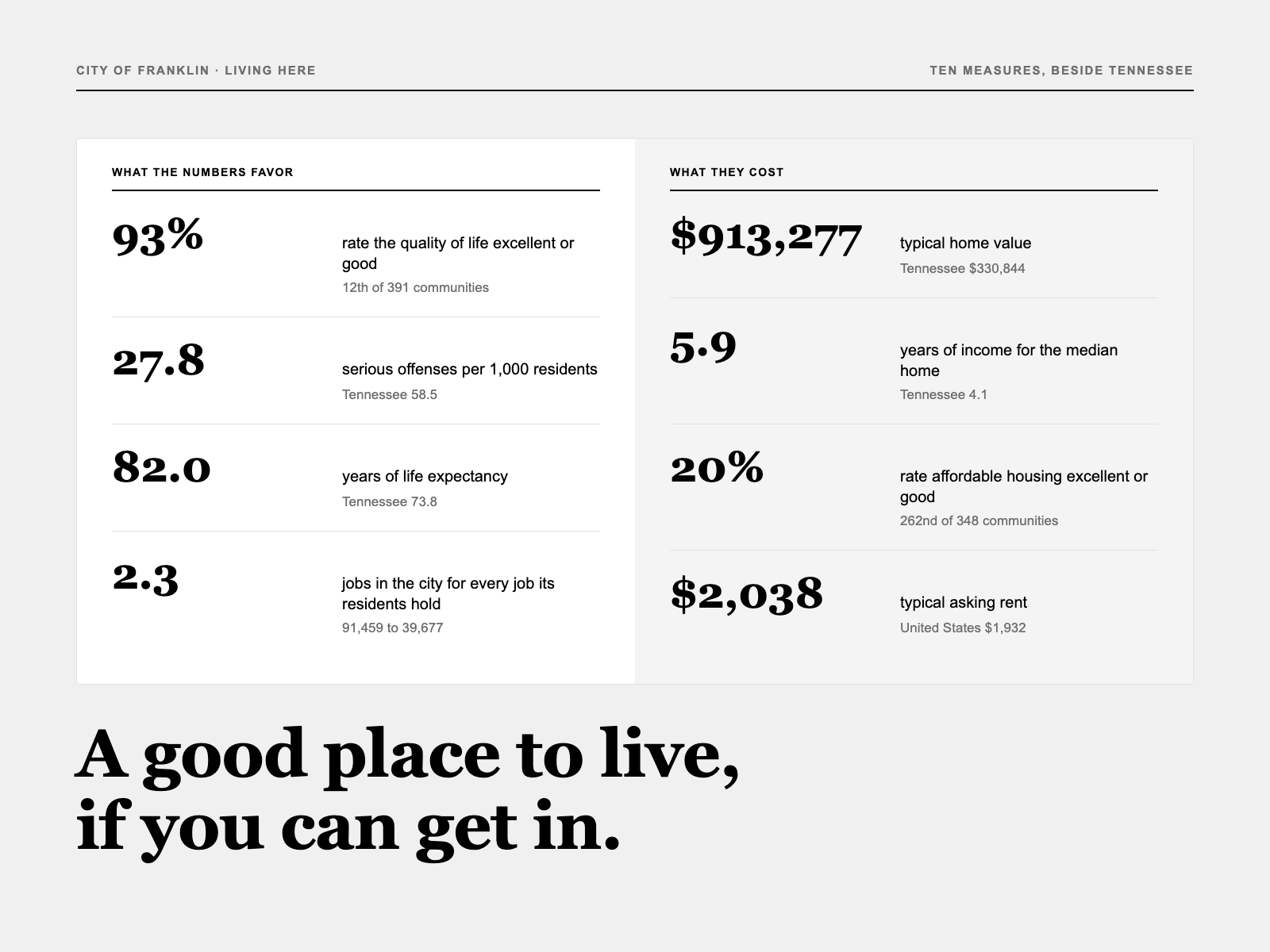
What residents say in the city's own survey, then the figures for cost, schools, crime, health, jobs, commuting, weather and the river, each beside the state's, and which households carry the costs.
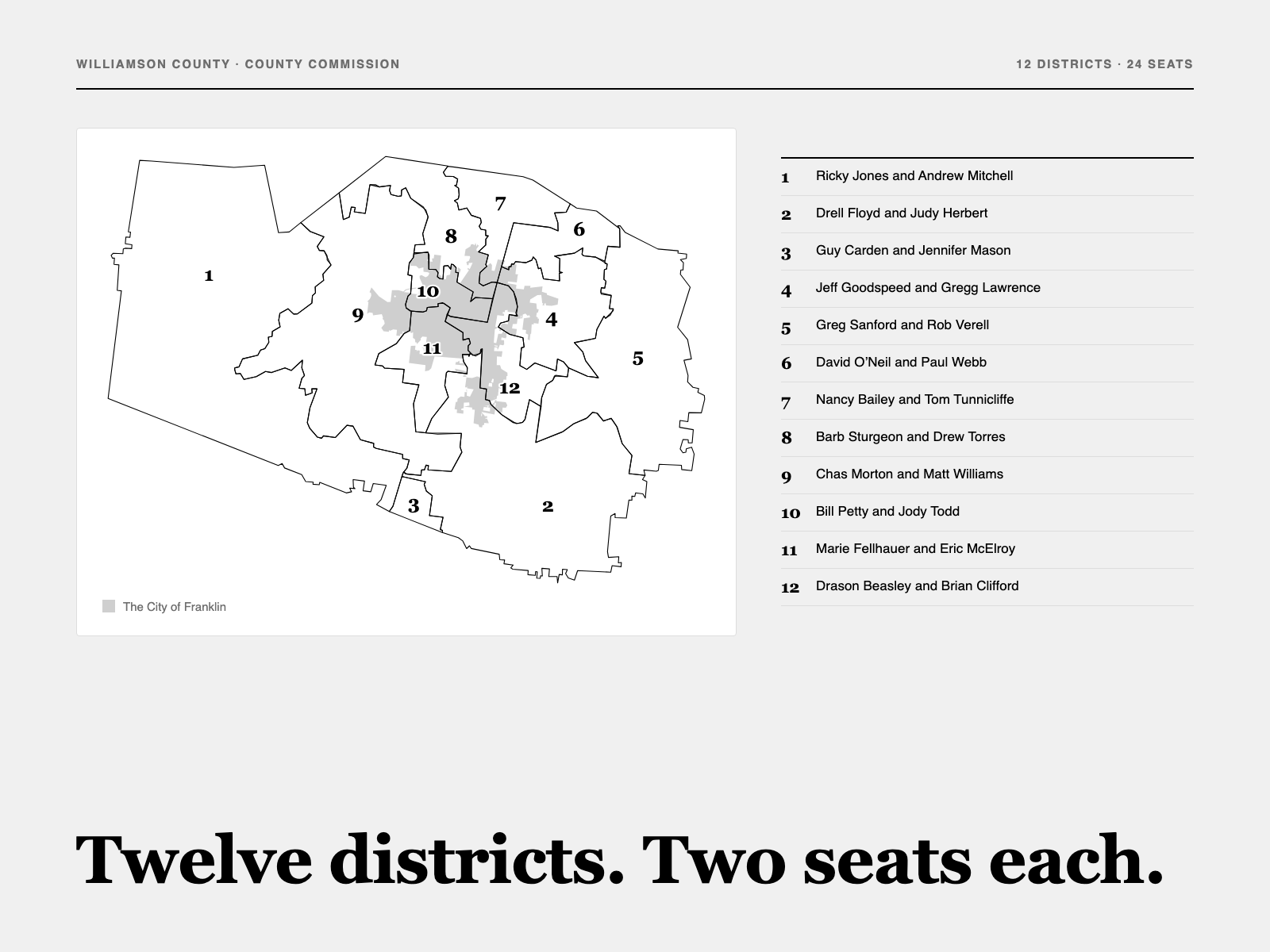
The 24 commissioners and their 12 districts, which two answer to your address, the $921.9 million budget and the tax rate they set in June, how a resolution passes with 13 votes, and how each of them voted in 2026.
Franklin's aldermen set utility rates years ahead, in budget meetings few residents watch. We read the ordinances and the rate studies and send the plain-English version before the bill changes, not after.