24
Commissioners, two for each of 12 districts
How Franklin works · County government
Williamson County is governed by a commission of 24, two from each of 12 districts. It adopts the county's $921.9 million budget, sets the property tax rate that is the largest part of every Franklin bill, borrows for school buildings, and will decide whether the county's hospital is sold. Which two commissioners answer to your address, how a resolution passes, and how each of them voted in 2026.
The City of Franklin
Williamson County's legislature is its County Commission, 24 members elected two to a district from 12 districts of about 20,600 people each. All 24 seats were on the ballot on August 6, 2026, and the commission that took office on September 1 has nine new members. The next election is Thursday, August 1, 2030.
The county mayor, Andy Marshall since September 1, runs the county government day to day and does not vote. The commission holds the purse. Each June it adopts the county budget, $921.9 million for the year that began July 1, and sets the property tax rate, $1.30 per $100 of assessed value, which is the largest part of every property tax bill in Franklin. It decides what the county borrows, and most of that borrowing builds schools. It zones the land outside the six cities, sets the fees on new houses that pay for classrooms, and, because Williamson Health belongs to a hospital district created for the county, it will decide whether the hospital is sold.
It acts by resolution, and a resolution needs 13 votes, a majority of all 24 seats, however many commissioners are in the room. From January 12 to September 14 it took 303 recorded votes at eight meetings; 245 were unanimous. The 58 that were not are where the county's arguments were: the June budget, the hospital, and the land for a new courthouse.
Every address in the county is in one of 12 districts, and each district elects two commissioners. The lookup below asks the State of Tennessee's address locator where an address is, then asks the county's own district map which district holds it and the City of Franklin's map whether it is inside the city. Your address goes from your browser to those public map services, not to us.
The example is the Franklin Theatre. The district comes from the county's map; the names come from the table in section 03, which we keep current. If the locator cannot place an address, the county's online map shows the districts as "Voting Districts 2020," and the state Comptroller's district lookup covers every county.
The commission adopted these lines on November 8, 2021, after the 2020 census counted 247,726 people in the county, and a map like it must be redrawn after every census. A Franklin mailing address can sit in any of nine districts, and in only one of them, District 10, is everybody a city resident. Downtown, the county's offices on West Main Street and both sites of the county's new justice buildings are in District 11; Williamson Medical Center is in District 12.
| District | Where its people live | People, 2020 | In Franklin |
|---|---|---|---|
| 1 | Fairview, the rural west and part of Spring Hill | 20,370 | None |
| 2 | The rural south and southeast, much of Spring Hill, and a corner of Franklin | 21,726 | 10% |
| 3 | Spring Hill, the part in Williamson County | 20,709 | None |
| 4 | Eastern Franklin along Carothers Parkway, and southeast Brentwood | 20,409 | 55% |
| 5 | Nolensville and the rural east | 21,434 | None |
| 6 | Eastern Brentwood | 20,769 | A sliver |
| 7 | Western Brentwood, and in Franklin, the Galleria and the shops on Mallory Lane | 19,640 | 2% |
| 8 | North Franklin and the unincorporated land toward Brentwood | 20,662 | 41% |
| 9 | Westhaven and west Franklin, part of Thompson's Station, and the rural land around them | 20,188 | 37% |
| 10 | Franklin north and east of downtown: Franklin Road, Hillsboro Road, Fieldstone Farms, Liberty Pike | 20,729 | 100% |
| 11 | Downtown, Columbia Avenue and Lewisburg Pike, and part of Thompson's Station | 19,666 | 76% |
| 12 | Southeast Franklin, from Williamson Medical Center to Peytonsville Road | 21,424 | 85% |
Our count: each 2020 census block placed in a district by the county's map, and in Franklin by the city's limits as they stood in October 2026, so annexations since 2020 count as Franklin. About 83,900 of the people counted in 2020 lived on land that is in Franklin today. The county has published no table of its own, and its map may differ from the adopted plan by a few blocks, so treat these as close rather than exact.
The two seats in a district are not numbered. Every candidate in a district runs in one field, each voter may choose two, and the top two win. A commissioner must live in the district, and nobody faces a term limit. On August 6, five districts had exactly two candidates; in the other seven a Democrat ran, and in District 10 one won: Jody Todd took the second seat by 159 votes over another Democrat, with the Republican who finished fourth 174 behind her. The commission is 23 Republicans and one Democrat.
| District | Commissioner | Votes, Aug. 6 | On the commission |
|---|---|---|---|
| 1 | Ricky Jones | 2,562 | Returning |
| 1 | Andrew Mitchell | 2,225 | New |
| 2 | Drell Floyd | 2,701 | New |
| 2 | Judy Herbert | 2,768 | Returning |
| 3 | Guy Carden | 1,418 | Returning |
| 3 | Jennifer MasonChairman pro tempore | 1,332 | Returning |
| 4 | Jeff Goodspeed | 1,835 | New |
| 4 | Gregg Lawrence | 1,639 | Returning |
| 5 | Greg Sanford | 2,241 | Returning |
| 5 | Rob Verell | 2,086 | New |
| 6 | David O’Neil | 1,789 | Returning |
| 6 | Paul Webb | 1,936 | Returning |
| 7 | Nancy Bailey | 2,115 | New |
| 7 | Tom Tunnicliffe | 2,095 | Returning |
| 8 | Barb Sturgeon | 2,352 | Returning |
| 8 | Drew Torres | 2,199 | Returning |
| 9 | Chas MortonChairman | 2,487 | Returning |
| 9 | Matt WilliamsChairs the Budget Committee | 2,626 | Returning |
| 10 | Bill Petty | 1,738 | Returning |
| 10 | Jody ToddThe one Democrat | 1,725 | New |
| 11 | Marie Fellhauer | 1,847 | New |
| 11 | Eric McElroy | 1,998 | New |
| 12 | Drason Beasley | 2,115 | New |
| 12 | Brian Clifford | 2,136 | Returning |
Votes are the Williamson County Election Commission's unofficial election-night count of August 6, 2026; the county had posted no certified count when we checked. "New" means first seated on September 1, 2026. Each name links to the commissioner's page here, with their 2026 votes and their email from the county's directory; email to them can be a public record.
Each September the commission elects a chairman from among its members to preside for a year. On September 14 it chose Chas Morton by voice vote, with Jennifer Mason as chairman pro tempore. The chairman votes as any member does but gets no second vote to break a tie. A commissioner is paid $600 a month and the chairman $650, under a rule in effect since September 2022. The proposed budget for 2026–27 carried $28,800 more for commissioners' pay; Drew Torres moved to take it out on June 18, and it came out 19 to 1. By state law a raise could not take effect before the term after the next election anyway.
When a seat falls empty, the commission itself fills it, by a majority of its members on a recorded vote after published notice, and the appointee serves until the next countywide election. Guy Carden came onto the commission that way in July 2025, nominated by Jennifer Mason, and won the seat outright on August 6.
The county mayor is the county's chief executive: elected countywide to a four-year term, in charge of the departments, and an ex officio member of the commission and all its committees, without a vote. Andy Marshall won the office on August 6 with 30,471 votes to 12,707 for the independent B K Muvvala, and took over from Rogers Anderson, mayor since 2002, on September 1. The mayor may veto a resolution, though never one item in the budget; the commission overrides with 13 votes within 20 days or at its next meeting, whichever is later.
What comes to the commission for a vote:
| The commission decides | For example |
|---|---|
| The budget and the property tax rate | $921.9 million and $1.30 per $100 for 2026–27, adopted June 18. Section 05 has the figures. |
| Borrowing | Bonds for schools, the jail and justice campus, parks and the courthouse land; up to $56.8 million of new bonds were on the October 12 agenda |
| Fees on new building | The education impact fee on a new house, from $1,803 to $13,299 outside the Franklin Special School District from July 1 |
| Zoning outside the cities | On the October 12 agenda: county zoning for about 837 acres Franklin de-annexed in July at the owners' request |
| The hospital | Any sale of Williamson Health, and the trustees it elects to the hospital's board |
| Appointments | Members of the county's boards, among them the Highway Commission, which picks the highway superintendent, and the Planning Commission, on the mayor's nomination |
| Asking the legislature | A private act for Williamson County takes effect only if two-thirds of the commission approve it, or the voters do |
Much of what county residents bring to the commission belongs to someone else. The schools are run by the elected Board of Education, whose 12 members are elected from the same 12 districts, one each, and by the Franklin Special School District's own board inside its lines; the commission funds the schools but cannot rewrite the school board's budget line by line. It can accept the school budget or send it back with a total. The sheriff, trustee, assessor of property, county clerk, register of deeds and court clerks are elected on their own, and the commission funds their offices without running them. Inside a city, zoning, roads and police are the city's: in Franklin, the Board of Mayor and Aldermen's.
The two governments meet at the edges. When Franklin's planning staff set conditions on the county's new juvenile justice center on Beasley Drive, the commission voted 20 to 1 on March 9 to overrule four of them, on parking and the building's design, under a state law that lets a public body overrule a planning decision on its own building by a majority of its members. In February it asked the legislature to give counties a say in annexations, 16 to 7, and all six cities passed resolutions against the request. The House bill closest to it failed in committee, 2 to 19.
The county's Budget Committee, the mayor and four commissioners, builds the budget from the departments' requests in the spring and brings it to a meeting of its own in June, where the commission votes on it category by category; the June 18 meeting took 28 recorded votes. The budget for 2026–27 came to $921.9 million, up 2.1 percent from $903.1 million, and most of it is the schools'.
| Fund | 2026–27 | Share |
|---|---|---|
| Schools' operating fundTeachers, buses and the upkeep of Williamson County Schools | $566,790,932 | 61.5% |
| General fundThe sheriff and jail, courts, parks, libraries, health, elections, administration | $184,873,195 | 20.1% |
| General debt servicePaying off bonds for county buildings and high schools | $70,141,417 | 7.6% |
| Rural debt servicePaying off bonds for Williamson County Schools' kindergarten-to-eighth-grade buildings | $43,985,037 | 4.8% |
| School cafeterias | $21,537,317 | 2.3% |
| Highway | $15,658,100 | 1.7% |
| Solid wasteRecycling and solid waste collection | $10,530,598 | 1.1% |
| Extended school programBefore and after school care | $8,226,127 | 0.9% |
| Drug control | $196,150 | Under 0.1% |
| Total | $921,938,873 | 100% |
From the adopted budget and the June 18 minutes. The commission voted $921,945,333 on June 18; on July 13 it corrected an addition error in the general fund, 24 to 0, and these are the corrected figures. School construction is not in this table: it is paid for with bonds and with the impact fee and the per-square-foot taxes on new building, in a capital budget the commission adopted on September 14.
About three-quarters of the money is raised locally: roughly $364 million from the property tax, after a reserve for what goes uncollected, and $142 million from the local sales tax, most of which by law goes to schools. The state sends about $185 million for schools through its funding formula. The schools also draw on the county's savings this year, $26.5 million of a $49.1 million draw across the funds.
The rate is set alongside the budget, one resolution of five lines. The Budget Committee proposed $1.33. On June 18 Chas Morton's amendment cut the schools' line from 80 cents to 77, which passed 13 to 7, the bare minimum, and the commission then adopted $1.30 by 17 to 3. It is the same total as 2025, with two cents moved from the general fund to the schools.
| Line, per $100 of assessed value | 2026 | Franklin, outside the FSSD | Franklin, inside the FSSD |
|---|---|---|---|
| General fund | $0.26 | Pays | Pays |
| Schools | $0.77 | Pays | Pays |
| General debt service | $0.15 | Pays | Pays |
| Rural debt serviceNot charged inside the FSSD, which builds its own schools | $0.09 | Pays | No |
| Solid wasteNot charged in Franklin or Spring Hill | $0.03 | No | No |
| The county's rate | $1.30 | $1.27 | $1.18 |
From the June 18 levy resolution and the county's 2026 rate sheet. The city's rate and the FSSD's own come on top; the property tax explainer adds them up for any address.
One cent on the countywide lines raises about $3 million a year. On a house appraised at $1 million, assessed at a quarter of that, each cent is $25 a year, so the three cents the commission took off the proposal in June kept $75 off such a house's bill. Behind the rate sits the county's debt: $1.12 billion in bonds outstanding on June 30, 2025, of which $646.6 million was for schools and $184.5 million was the hospital's, repaid from its own revenue. Moody's rates the county Aaa, its best grade.
The commission meets at 6 p.m. on the second Monday of nine months, in the auditorium of the Williamson County Administrative Complex, 1320 West Main Street in Franklin. There is no meeting in April, August or December. The budget meeting comes at 9 a.m. on the Thursday of the week after the June meeting; the mayor can call a special meeting, as on September 9. Every regular meeting is shown live on WC-TV, the county's channel, on YouTube and on cable (Comcast 3, Charter 192, AT&T 99), and the recordings stay on its commission playlist. Agendas, packets and minutes are on the county's Agenda Center.
| Date | Meeting |
|---|---|
| Monday, Nov. 9, 2026 | Regular meeting, 6 p.m. The last of the year |
| Monday, Jan. 11, 2027 | Regular meeting, 6 p.m. |
| Monday, Feb. 8, 2027 | Regular meeting, 6 p.m. |
| Monday, March 8, 2027 | Regular meeting, 6 p.m. |
| Monday, May 10, 2027 | Regular meeting, 6 p.m. |
| Monday, June 14, 2027 | Regular meeting, 6 p.m. |
| Thursday, June 24, 2027 | The budget and the tax rate, 9 a.m. |
From the commission's Rule 1, as amended July 13, 2026. The rest of 2027: July 12, Sept. 13, Oct. 11 and Nov. 8.
Only a commissioner can sponsor a resolution. It is filed with the county clerk by noon 14 days before the meeting and goes first to a committee: Budget for anything that spends money, and otherwise one of the standing committees, Education, Property, Public Health, Law Enforcement and Public Safety, or Tax Study, which meet on weeknights at the Administrative Complex. A committee recommends and decides nothing. A resolution filed late can still be heard unless two commissioners object, which is how a hospital consultant resolution never reached the floor on July 13.
On the floor, a resolution passes with 13 votes, a majority of all 24 seats, not of those present. An abstention counts the same as a no. On March 9, with 21 in the room, a motion drew 11 votes to 10 and failed. A few things take two-thirds, 16 votes: approving a private act, reconsidering a vote at a later meeting, and changing the commission's own rules; ending debate takes two-thirds of those present. A tabled resolution can be taken up again by a majority at any meeting, and dies if nobody has done so by June.
Borrowing for county buildings has two more steps. The commission first adopts an initial resolution, which the county publishes with a notice: if 10 percent of the county's registered voters sign a petition against the bonds within 20 days, they cannot be issued without a referendum. Then a detailed resolution sets the terms. The courthouse land shows both. The initial resolution for $17.85 million failed 11 to 11 on February 9 and passed in May; the detailed one was deferred four times and adopted on July 13, 23 to 1.
We read the minutes of the eight meetings the county has posted from January 12 to September 14 and recorded every vote with a count: 303, counting each department's budget on June 18 as its own vote, as the commission did. 245 were unanimous. Fifty-eight drew at least one no, and 11 failed. The minutes print every recorded vote with a table of names, so each commissioner's record below comes straight from the page.
The arguments cluster. Eighteen of the 58 split votes came at the June 18 budget meeting, 12 concerned Williamson Health, seven the courthouse land and four the request to the legislature on annexation. The narrowest results were 13 to 7, the schools' tax rate, and 13 to 10, twice on September 14, both on the hospital.
| Commissioner | Votes cast | Voted no | Not voting |
|---|---|---|---|
| Ricky JonesDistrict 1 | 274 | 6 | 29Absent June 18; out of the room for one |
| Andrew MitchellDistrict 1, new Sept. 1 | 75 | 1 | 0 |
| Drell FloydDistrict 2, new Sept. 1 | 75 | 1 | 0 |
| Judy HerbertDistrict 2 | 302 | 15 | 1One abstention |
| Guy CardenDistrict 3 | 232 | 13 | 71Absent Sept. 14 |
| Jennifer MasonDistrict 3 | 261 | 18 | 42Absent March 9; one abstention |
| Jeff GoodspeedDistrict 4, new Sept. 1 | 75 | 3 | 0 |
| Gregg LawrenceDistrict 4 | 303 | 11 | 0 |
| Greg SanfordDistrict 5 | 268 | 8 | 35Absent Feb. 9; two abstentions; out of the room for three |
| Rob VerellDistrict 5, new Sept. 1 | 75 | 1 | 0 |
| David O’NeilDistrict 6 | 303 | 11 | 0 |
| Paul WebbDistrict 6 | 297 | 12 | 6Two abstentions; out of the room for four |
| Nancy BaileyDistrict 7, new Sept. 1 | 75 | 3 | 0 |
| Tom TunnicliffeDistrict 7 | 300 | 23 | 3Three abstentions |
| Barb SturgeonDistrict 8 | 219 | 10 | 84Absent June 8 and June 18 |
| Drew TorresDistrict 8 | 246 | 11 | 57Absent June 8; arrived after the first vote Jan. 12 |
| Chas MortonDistrict 9; chairman | 303 | 14 | 0 |
| Matt WilliamsDistrict 9 | 303 | 18 | 0 |
| Bill PettyDistrict 10 | 302 | 10 | 1One abstention |
| Jody ToddDistrict 10, new Sept. 1 | 75 | 2 | 0 |
| Marie FellhauerDistrict 11, new Sept. 1 | 75 | 1 | 0 |
| Eric McElroyDistrict 11, new Sept. 1 | 75 | 2 | 0 |
| Drason BeasleyDistrict 12, new Sept. 1 | 75 | 2 | 0 |
| Brian CliffordDistrict 12 | 232 | 8 | 71Absent March 9 and June 18; two abstentions |
Every recorded vote counts, amendments, deferrals and procedure included. A new commissioner's count starts on September 1, when the nine took office, and covers the 75 votes at the September 9 and 14 meetings. Four voice votes with no count and no names are left out: three elections of a chairman and one set of board appointments. The minutes of May 11, approved on June 8, were not on the county's site when we checked, and the minutes of October 12 will be posted after the commission approves them on November 9. The nine commissioners whose terms ended on August 31 have their records on their own pages.
Tom Tunnicliffe cast the most no votes among the sitting commissioners, 23. Eleven came at the budget meeting, where he voted against most of the cuts: alone against removing the commissioners' raise, against the benefit and insurance cuts in five funds and the deeper cut to the schools, against taking three cents off the schools' rate, and then against the $1.30 rate itself. The new members' first meeting was the hospital's. A no is a vote against the motion on the floor, which is not always the project: on September 9 Drew Torres voted to keep debating and to defer the letter of intent, then voted for it once the deferral failed. Each commissioner's page lists every split vote of the year with how they voted, linked to the page of the minutes that records it.
Williamson Health, the hospital system built around Williamson Medical Center on Carothers Parkway, belongs to a hospital district the General Assembly created for the county in 1957. Its own board of trustees runs it, and the commission elects most of them. In July 2025 the board said it was weighing a sale or a partner, citing costs and the money it would need over the next five years, and since then the question has run through the commission's year.
The draft term sheet in the September 9 packet sets the price at $700 million, free of the hospital's debt, plus $270 million in commitments over ten years: $195 million of new capital, among it new places to get care, $40 million of routine capital, about $15 million for a new records system, and $4 million a year to the county for five years in place of property taxes. Ascension would keep the children's emergency department, offer every employee a job with no layoffs for a year, run the county's ambulance service under contract, follow the Catholic directives that govern its hospitals, and have a local board. The signed letter itself has not been posted.
The five no votes on September 9 were Jeff Goodspeed and Gregg Lawrence of District 4, Barb Sturgeon of District 8, and Bill Petty and Jody Todd of District 10. Before a sale can close, the commission must approve the purchase agreement itself, by 13 votes; the letter says so, and so does the hospital district's act as amended this spring. The state attorney general must also review the sale: the hospital gives notice at least 45 days before closing, publishes it, and takes written comment.
Two building decisions sit in Franklin. The county is buying 5.6 acres at 926 Columbia Avenue, the H.G. Hill land, for $17.5 million as the site of a new courthouse; the commission approved the purchase 24 to 0 on July 13, and a task force chaired by Drew Torres is to plan it, with the Public Building Authority overseeing construction. Franklin's mayor and city administrator voted against the site on the county's courthouse task force in June. The juvenile justice center broke ground at 306 Beasley Drive on March 18, the first building of the county's jail, juvenile and judicial campus, due in the summer of 2028.
Every regular meeting opens with 30 minutes of citizen communication. Sign up before the meeting with your name and the city you live in; you do not have to give an address. Each speaker gets three minutes, less if more than ten sign up, since the half hour is shared evenly. You may speak on anything in the county's business, on the agenda or not, but the commission takes no vote on what is not on the agenda, and commissioners do not answer from the dais. On September 14 residents spoke about a moratorium on data centers and the county's fire code.
After that, a resident speaks during debate only if a commissioner moves it and a majority of those present agree. On September 14 a motion to let one resident speak on the hospital consultant passed 13 to 10. At a zoning hearing everyone present may speak, three minutes each.
Committees are where a resolution is shaped, and since June each committee meeting sets aside 15 minutes for comment on anything in the commission's business, as a new state law requires. The committees meet on weeknights at 5:30 p.m. at the Administrative Complex, and the Budget Committee at 4:30 p.m. on the first Monday of the month. Your two commissioners' addresses, phones and email are in the county directory, and on their pages here.
All 24 seats and the county mayor are next on the ballot on Thursday, August 1, 2030, the county general election, held on the first Thursday in August of even years. The parties' primaries come that May, and the winners take office on September 1, 2030. Candidates qualify with the Williamson County Election Commission by a deadline in February of the election year.
The county's August ballot carries other offices in between. In 2028 it will elect the assessor of property and the school board members for the odd-numbered districts; on August 6 this year it elected the sheriff, trustee, county clerk and register of deeds, all unopposed, and school board members for the six even-numbered districts. Franklin's own election falls on a different calendar: the mayor and four aldermen at large are next on the ballot on October 26, 2027, and that is explained in the board explainer.
The rules are from state law, as the University of Tennessee's County Technical Assistance Service summarizes it, and from the commission's own rules, adopted in 1983 and amended by resolution since; we read the 2023 text and every amendment we found in the minutes through July 2026. The members, officers, committees and pay are from the minutes and the county's pages. The 2026 vote record is our own, from the tables of names in the eight sets of minutes the county has posted. The budget is the adopted budget book and the June 18 minutes. The hospital's terms are from the draft term sheet in the September 9 packet; the signed letter has not been posted. The districts are the county's map, which the lookup asks live; the populations and the share in Franklin are our count of 2020 census blocks against it. Election results are the county's unofficial election-night counts, the only ones posted. The stamp at the top says when we last checked.
tools/county-districts-map.mjs), its incorporated areas, and the official voting district map approved November 8, 2021. The State of Tennessee's address locator; the City of Franklin's city limits layer, updated October 6, 2026; the U.S. Census Bureau's 2020 block populations.Next
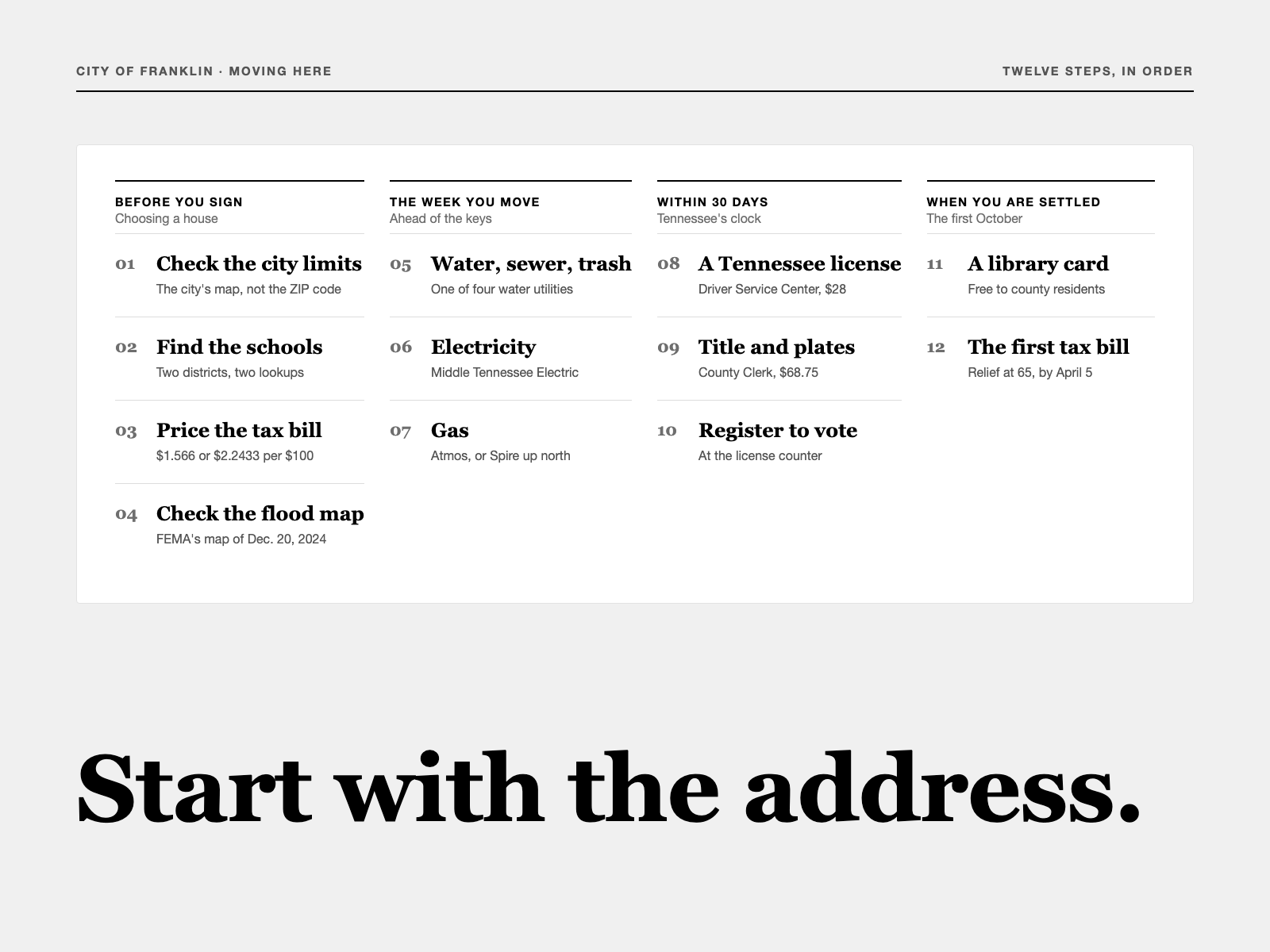
Twelve steps in the order they fall due: what to check before signing, what to start the week you move, and the 30-day clock on a license, plates and a voter registration.
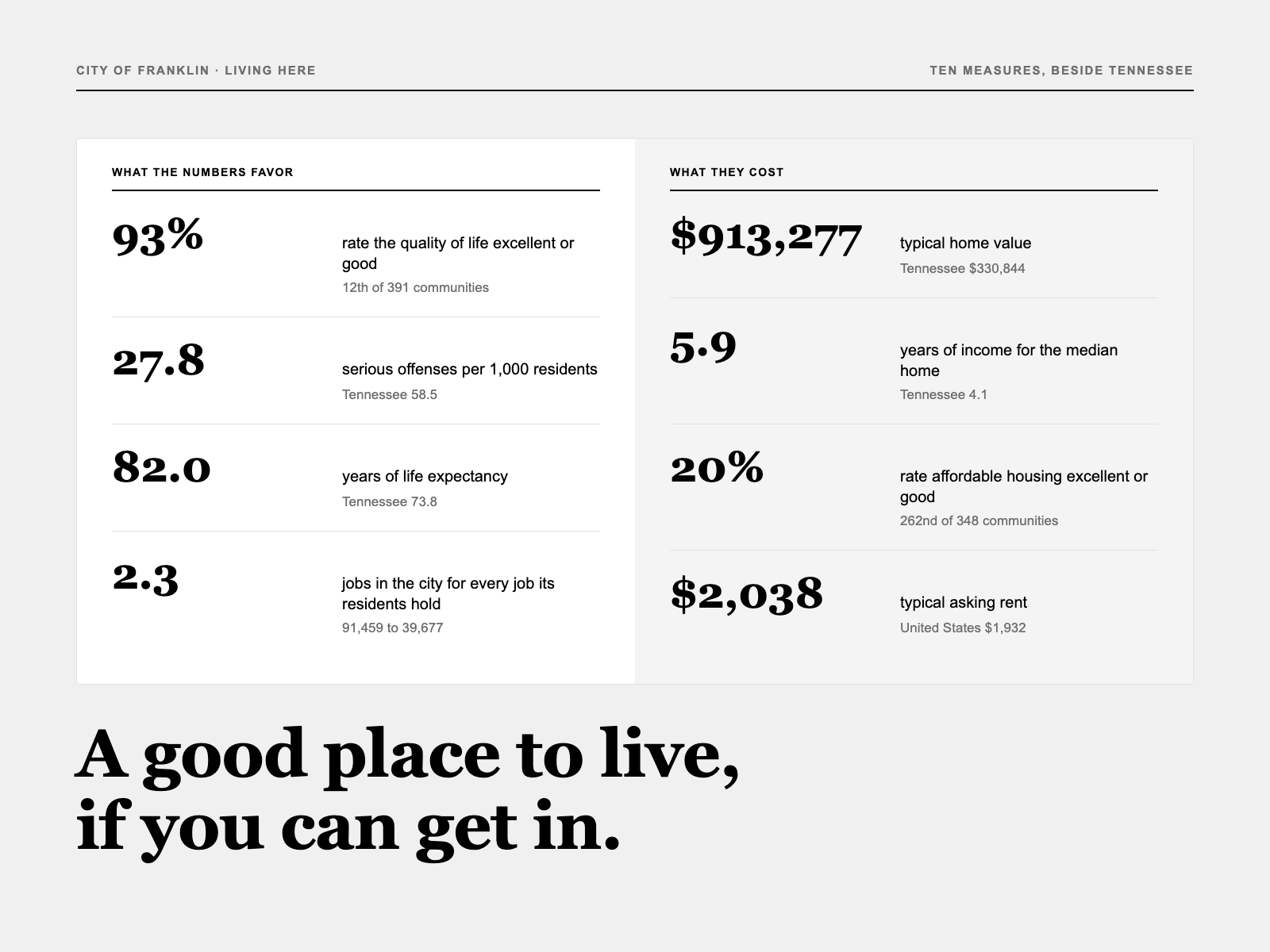
What residents say in the city's own survey, then the figures for cost, schools, crime, health, jobs, commuting, weather and the river, each beside the state's, and which households carry the costs.

The town the rest of the county is measured against. What a house costs by tier, the county-city-FSSD tax stack with a worked example, two school districts and four high schools, the honestly timed I-65 commute, the six character areas, the 2026 festival calendar, and the trade-offs nobody selling a house will mention.
The commission meets nine Mondays a year, and its packets can run past a hundred scanned pages. Every Monday morning the email says what is on the week's county and city agendas, and when the hospital's purchase agreement reaches the commission, it will say what is in it and, after the vote, who voted which way.